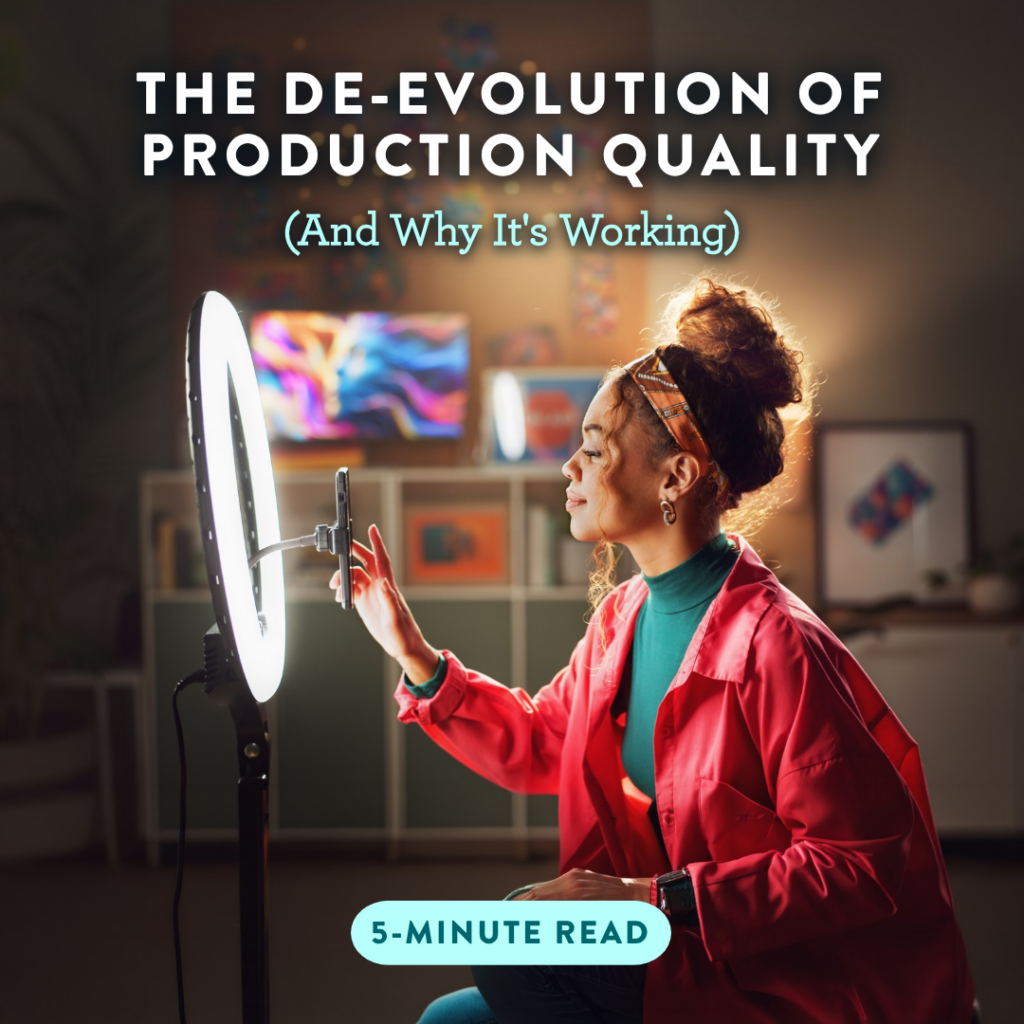

The De-Evolution of Production Quality (And Why It’s Working)
3 Minute Read
For two decades, the trajectory of content was one direction only: up. Higher resolution, sharper grades, slicker cuts, bigger rigs. Every year, the gear got better, and the expectations got steeper. Then TikTok happened, and somewhere along the way, the most-watched videos on Earth started looking like they were shot by someone running late for a bus.
This isn’t an accident. It’s a correction. And if you make content for a living, it’s worth understanding why the slickest thing in the room is now often the thing that loses.
The Polish Penalty
There’s a phenomenon every creator on the platform eventually runs into: post something that looks expensive, and people scroll. Post something that looks like your cousin filmed it in a parking lot, and it has 1.2 million views.
The reason is structural. TikTok’s feed is built on a single, brutal metric. Does the viewer stay or leave in the first second? A glossy, color-graded opening with a slow logo sting reads instantly as advertisement, and the thumb keeps moving. A slightly shaky vertical shot of a person mid-sentence reads as someone is about to tell me something, and the thumb stops.
High production value used to be a trust signal. It said, “A real company made this; you can take it seriously.” On TikTok, that same signal now triggers the opposite reflex. Polish means someone is selling. Roughness means someone is sharing.
What Actually Got Worse (On Purpose)
The “de-evolution” is real and specific. The things production crews spent years perfecting are exactly the things native TikTok content throws away:
Lighting got worse, flat, available, often just a window or a ring light. Audio got worse, built-in mic, room tone, the occasional clip of wind. Stabilization got worse; handheld is a feature now, a sign of authenticity. Color got worse, straight-out-of-phone, no grade, no LUT. Framing got worse, heads cut off, dead space, reframes mid-shot.
None of these are mistakes anymore. They’re a visual language. A perfectly exposed, tripod-locked, color-graded talking head now signals “corporate” faster than any disclaimer could.
But “Low Quality” Is a Trap Word
Here’s the nuance that separates people who get this from people who just shoot ugly footage and wonder why it flops: production value went down, but production intelligence went way up.
The craft didn’t disappear. It moved. It relocated from the surface, the grade, the rig, and the lighting kit, into the parts the audience can’t see but absolutely feels:
The first frame. The single most important production decision is now what’s on screen at 0.0 seconds. That’s a real creative choice that takes real skill; it just isn’t a camera choice.
The hook. Pacing in the first three seconds is engineered down to the syllable. The best “casual” videos are scripted within an inch of their lives.
The cut rhythm. Native edits are fast, but not random. The tempo of cuts, the placement of captions, the timing of a beat drop, that’s editorial craft as demanding as anything in a broadcast suite.
The captions. On-screen text isn’t an afterthought; it’s a parallel script for the 80% watching on mute.
So the work didn’t get easier. It got reallocated. The money and effort that used to go into making something look good now go into making something perform, and performing means looking like it didn’t take effort at all.
Why This Matters for Brands and Producers
If you’re producing branded content, this is the genuinely hard part: clients still equate spend with polish. They want to see where the money went. A flat, handheld, ungraded vertical video looks to a client like you didn’t do your job, even when it’s the version that will actually work.
The job now includes managing that gap. The real deliverable isn’t just the content; it’s the case for why the content looks the way it does. The skill is knowing when to deploy polish (a :30 hero that lives on YouTube and connected TV) and when to deliberately strip it away (the native social cuts that need to disappear into the feed).
The smartest production shops aren’t choosing one or the other. They’re shooting in a way that can flex, capturing enough quality to grade up for the premium placements while cutting native, rough, hook-first versions for the feed. Same shoot, two completely different visual grammars, because the platforms reward opposite things.
The De-Evolution Is Really a Re-Evolution
Calling it “de-evolution” is half a joke. Production didn’t regress; it shed a skin it no longer needed. For a long time, looking expensive was the value, because looking expensive was hard and rare. Phones have made it cheap and available everywhere. So value did what value always does when something becomes commoditized: it moved to the next scarce thing.
The scarce thing now is attention, and attention rewards the feeling of authenticity over the appearance of investment. The crews who win are the ones who figured out that “make it look like nobody made it” is one of the hardest production briefs there is.
The gear got smaller. The lighting got flatter. The footage got shakier. And the craft? The craft just went underground, where the audience can’t see it, which is exactly where it does its best work.