
In the 1980s, A&W did something that should have worked. It put a bigger burger on the menu for the same price as the competition, then watched it fail. The story of the third-pound burger has become marketing folklore, usually told as a punchline about bad math. It’s a small story with a surprising amount to teach. Let’s dig in.
A Better Burger Nobody Bought
A&W’s third-pound burger was built to beat McDonald’s Quarter Pounder. More beef, same price. On paper, it was the better deal, and A&W had every reason to expect a winner. There was just one problem: customers didn’t bite. The third-pound burger went down as one of fast food’s most famous flops. Not because the product was worse, but because the pitch asked for a little mental math nobody signed up for.
Start With the Math
It begins with the obvious suspect: customers thought a third of a pound was smaller than a quarter of a pound, because three is less than four. Cue the jokes about America’s math skills.
It’s a great story, and A&W tells it themselves. It also deserves a small asterisk. The explanation traces back to A&W’s own account of what went wrong, and Snopes and others have noted it’s more accepted legend than airtight proof; by A&W’s own telling, only about half the focus group made the mistake. But the reason it has stuck around for forty years is that it points at something real.
Why 1/4 Can Feel Bigger Than 1/3
There’s an actual name for the glitch behind the joke: whole number bias, the habit of judging a fraction by its parts instead of its whole value. For some people, the brain latches onto the bottom numbers and reads them like ordinary whole numbers. Four is bigger than three, so 1/4 can feel like more, even when a second of thought says otherwise.
And this isn’t a “people are bad at math” story. Researchers find the same pull in adults, and traces of it show up even in expert mathematicians, who are simply quicker to catch themselves. The instinct never fully goes away; we just learn to override it when we slow down. The trouble is that nobody standing at a fast-food counter is slowing down. Educators see it in classrooms constantly, which tells you it isn’t a customer failing. It’s a human default. And A&W built a campaign that ran straight into it.
The Name Deserves Some Blame
Here’s where it gets interesting for marketers. Even a customer who could do the fraction in their sleep might still have reached for the Quarter Pounder, simply because of how the two burgers sounded.
“Quarter Pounder” is easy. Easy to say, easy to picture, easy to trust. A quarter is a coin you can see in your hand. “Third-pound” is a mouthful wrapped around an abstract fraction. Psychologists call the difference processing fluency, and it’s not a soft idea. In one well-known study of the stock market, companies with easy-to-pronounce names measurably outperformed hard-to-pronounce ones in their first days of trading. A $1,000 stake in the fluent names beat the clunky ones by over $100 on day one. Same market, same information, different names. When people don’t have much else to go on, “easy-to-process” quietly wins.
Framing stacks on top of it. The same fact lands differently depending on how you say it: “kills 95% of germs” beats “5% of germs survive,” and “80% fat-free” beats “20% fat,” even though each pair is identical. A&W handed customers a comparison to work out. McDonald’s handed them a name. Same burger reality, opposite framing. The frictionless one won.
The fraction was a culprit, but the misfire ran deeper: asking the customer to do the work at all. The value was there, but it was buried behind a calculation, an awkward name, and a frame that made the better deal feel like homework.
The Comeback: Owning the Joke
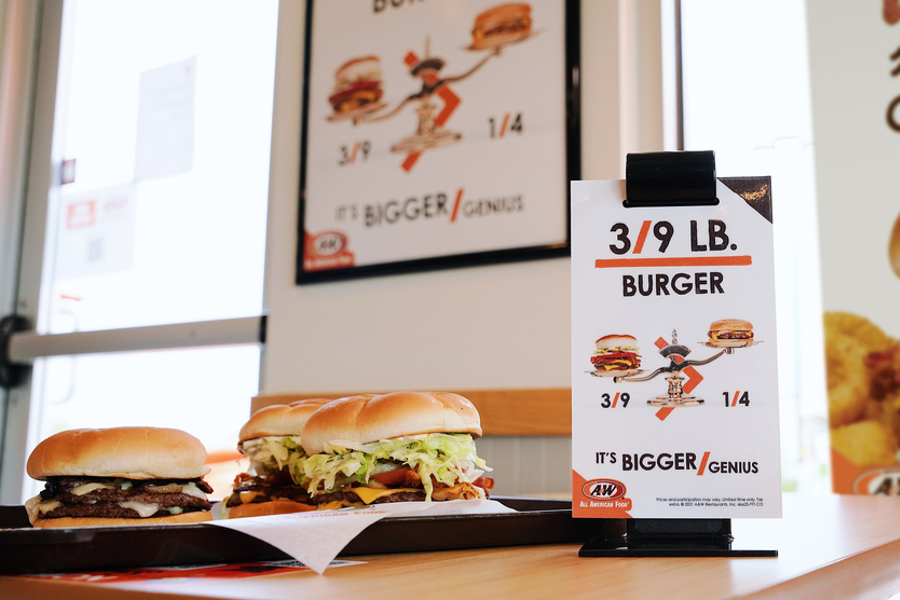
The best part of the story is the ending. Decades later, in 2021, A&W leaned all the way into the legend. They “reintroduced” the burger as the 3/9 Pound Burger: a bigger-looking number to finally out-math the Quarter Pounder, complete with their mascot, Rooty the Great Root Bear, playing the genius who cracked the math at last.
It worked, and it worked for a reason worth remembering: A&W didn’t correct anyone. No fractions lesson, no food-science explainer. They turned their most famous failure into an inside joke the whole audience was in on, and earned a wave of attention and goodwill for it. The flop became the campaign.
What It Actually Teaches
The third-pound burger isn’t just a story about customers who couldn’t count. It’s a reminder that the burden of being understood sits with the brand, never the buyer. If your audience has to do math, decode a name, or work to see why you’re the better choice, most of them won’t. Make the value obvious, or watch a better product lose to an easier one. A&W learned it the hard way twice: first by accident, then, wisely, on purpose.