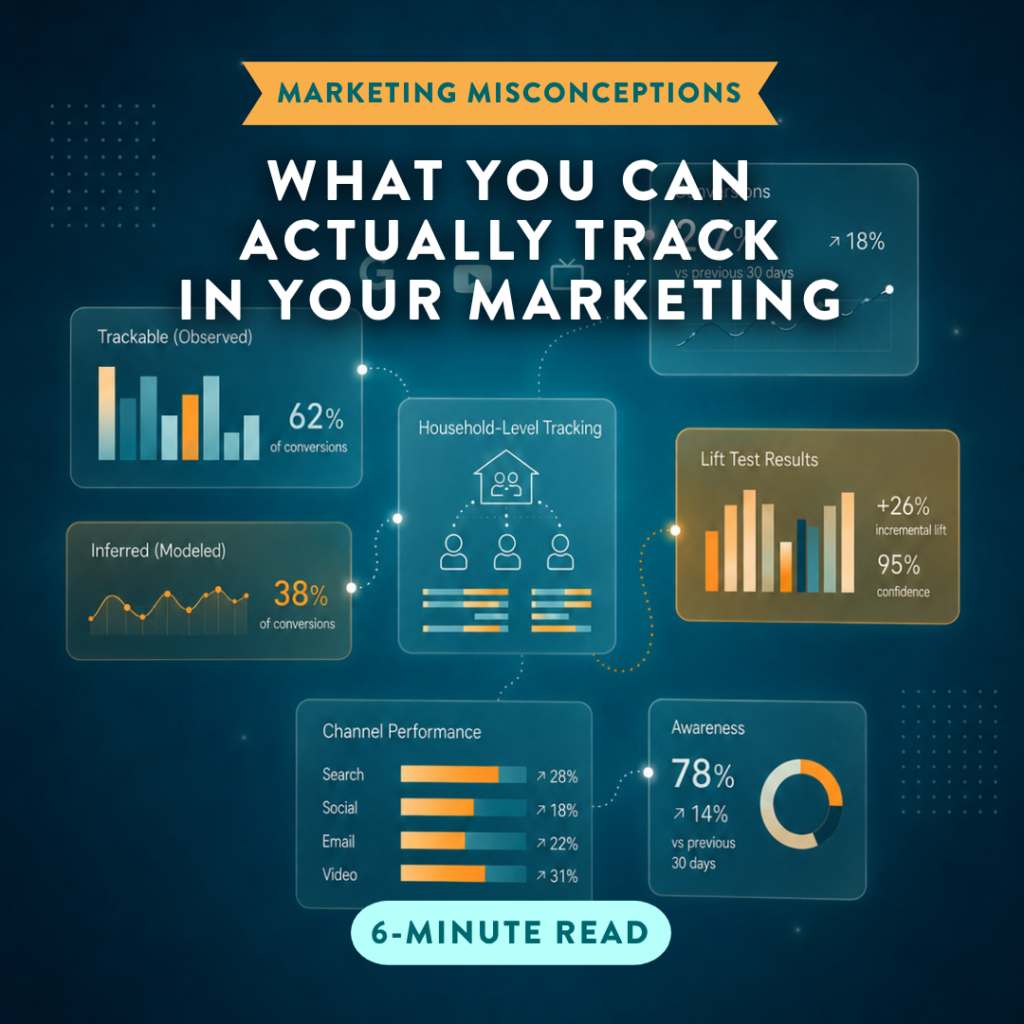

Marketing Misconceptions, Vol. 2: What You Can Actually Track in Your Marketing
6 Minute Read
Part of our Marketing Misconceptions series, where we tackle the assumptions that quietly sabotage good marketing decisions.
Clients keep asking: “Can we track everything? From the first time someone sees our ad to the moment they buy?”
It usually comes up partway through a planning meeting, often from the person holding the budget. It’s a fair question. And this is something to think about, because it reshapes how you spend, what you measure, and which channels you trust to do real work.
Overview
You can’t track everything in marketing, but you can track far more than most marketers actually use. Search ads and email give near-complete pictures. Streaming TV and online video give partial but powerful signals. Linear TV, radio, podcasts, and billboards have to be measured indirectly. The marketers winning in 2026 aren’t trying to track every channel the same way. They’re using every form of measurement available, and recognizing that most ads do more than one job at the same time.
The Two Misconceptions That Sabotage Marketing Decisions
Misconception #1: “We can track everything.”
This shows up in marketing meetings like a reflex. Someone says, “We need to know exactly which ad drove that sale,” and the room nods like it’s obviously possible.
Today, upwards of 40% of conversions never connect cleanly back to the ads that influenced them. That gap is the cumulative result of privacy laws, browser changes, ad blockers, and multi-device journeys too messy for any single tool to follow end-to-end.
Misconception #2: “We’re tracking the basics; that’s good enough.”
This is the more common and more expensive mistake, and we’ve sat on both sides of it. Most marketers track something. They watch click-through rates and last-click conversions, then call it a day. They’re using maybe 30% of what modern measurement can actually show them.
What they miss is the bigger picture: the lift their TV ads created in branded search the next week, the tests that would show what happens if they paused a channel, or the assist conversions from ads that helped without getting the final click.
The misconception is hard to spot because the dashboards look fine. The decisions made from those dashboards are quietly biased toward whatever’s easiest to measure (usually conversions) and blind to the channels that are building the brand and creating future demand.
The fix isn’t to abandon tracking or demand perfection from it, but to use more of what’s already available, and use each piece for what it’s good at.
Which Marketing Channels Can You Actually Track End-to-End?
Tracking lives on a spectrum. Here’s how the major channels break down.
Highly trackable: Search ads, email, and social media clicks
These give the cleanest picture. Someone clicks a Google Ad, lands on your site, and buys. The path is visible: keyword, landing page, time on site, and dollars spent. With email, you can see who opened, clicked, and bought.
Imagine these channels as a well-lit room. You can see what’s happening. The shadows are small.
Moderately trackable: YouTube, online video, and display ads
This is where most marketers stop digging and where the biggest signal is sitting unused.
Most people look at the click number, see it’s low, and assume the channel isn’t working. But the click was never the only point. Hidden in your reporting are the impressions that didn’t get clicked but still influenced someone to convert later through a different ad. Someone sees your YouTube ad on Tuesday, scrolls past, then searches your brand on Friday, clicks your search ad, and buys. Under default reporting, Search gets full credit. The YouTube impression that started the chain looks like it did nothing.
It didn’t do nothing. The data to see it is right there, in the Attribution Paths report and through data-driven attribution models. Most marketers never open those reports, and as a result, systematically undervalue the channels doing the early work.
Household-level: Streaming TV (Hulu, Paramount+, YouTube TV, Roku)
Streaming TV was sold as the next great trackable channel, and it is, but not the way Google Search is. You can’t click a TV. There’s no pixel firing on your screen.
What streaming platforms can do is recognize when someone in your household later visits the advertiser’s website on another device and credit the ad for that visit. So a Hulu ad seen Tuesday night can get credit for a Friday morning website visit on a phone. The result is real but household-level, which is enough for most marketing decisions.
Inferred only: Linear TV, podcasts, billboards, print, radio
These channels move business, but they don’t have pixels. They’re measured through proxies: branded searches that spike after a campaign airs, traffic increases in target cities, promo code redemptions, vanity URLs, and statistical models that isolate each channel’s contribution from the noise.
If someone promises click-by-click attribution from a podcast or billboard, they’re selling you something. The right answer isn’t avoiding those channels. It’s measuring them with the right instruments.
Why Don’t My Marketing Platforms Agree on Conversions?
Because they count differently. Each platform uses its own rules: last-click versus last-view, different attribution windows, and different ways of avoiding double-counting. Google Ads might show 30 conversions while Meta shows 50 for the same campaign. Neither is wrong. They’re partial views of the same truth, counted with different rules.
Anyone who’s had to explain this to a CFO knows how awkward the conversation gets. The fix isn’t reconciling the platforms. It’s picking one source of truth (usually your website analytics or your CRM) and treating platform numbers as a directional signal.
Most Ads Do More Than One Job. Measure Them That Way.
The real question isn’t “How do I track everything?” It’s “How do I measure the full value each ad is actually creating?”
The mistake: judging an ad on a single outcome
Most marketers measure a display ad from conversions alone. The ad gets seen by 100,000 people, clicked by 1,000, and converts 50. The conversion rate looks low. The CPA looks high. The decision: Cut the campaign.
This decision gets made in marketing meetings every week, and it almost always looks like the responsible call. But here’s what it misses: The 99,000 people who saw the ad and didn’t click still got something out of it. Your brand is now slightly more familiar to them. The 950 people who clicked, but didn’t convert, engaged with your site, dropped into your retargeting pool, and now have a real chance of converting on a future touch. The same ad created awareness value, engagement value, and conversion value. Three jobs, one campaign.
Judging it on conversions alone isn’t just incomplete. It’s misleading.
Why this matters more for higher-consideration purchases
The bigger the purchase, the more touches it takes. Almost no one sees one ad for a $30,000 product and immediately buys. They see it, sit with it, see it again, search the brand, read a review, get retargeted, and eventually decide. Every touch has value, but only the last one shows up in a conversion report if that’s how you’re attributing it.
What to do instead
Judge each campaign on the mix of jobs it’s actually doing. A display ad is partly awareness, partly engagement, partly conversion. Measure all three. A streaming TV ad is mostly awareness with some engagement. Measure for reach, frequency, and branded search lift. A search ad is mostly conversion-based. Measure for CPA and ROAS.
Balanced marketing programs run channels that do different combinations of jobs. Balanced measurement programs measure all of those jobs.
Three Takeaways
- Stop measuring every channel by a single yardstick. Most ads do multiple jobs at once. Held to one KPI, the others disappear.
- Use more of the measurements that are already there. If you’re only watching last-click conversions, you’re seeing maybe a third of what your data could tell you.
- Use lift testing for channels you can’t track directly. Comparing exposed audiences against control groups is the most honest way to measure streaming TV, podcasts, and other channels that don’t generate clicks.
The marketers winning aren’t the ones with the most precise dashboards. The ones winning are the ones who’ve gotten comfortable with the parts of measurement that don’t show up in a neat row, and who use every form of signal available to them.
Frequently Asked Questions
Can streaming TV ads on Hulu, Paramount+, or YouTube TV be tracked?
Yes, at the household level. Streaming platforms recognize when someone in the household sees the ad, and then match that to website visits or app activity from any device on the same home network. It’s powerful but probabilistic, measured in lifts and matches rather than clicks.
Why don’t my conversion numbers match between Google Ads, Meta, and my website analytics?
Each platform uses different rules for what counts as a conversion, how long the window is, and how to avoid double-counting. They’re all partially right. Pick one source of truth (usually your website analytics or your CRM) and treat platform numbers as a directional signal.
Is marketing attribution still worth investing in if it’s only partly accurate?
Yes. Imperfect data still beats no data, and modern measurement captures enough signal to make better decisions than gut feel, meaningfully. The goal isn’t perfection. It’s better decisions than the next-best alternative.
How does Strive Creative approach marketing measurement?
We use a proprietary AEC framework (Awareness, Engagement, Conversion) that judges each tactic by all the jobs it’s actually doing, rather than holding every channel to last-click ROI. We pair the strongest available tracking for each channel with lift testing where direct attribution falls short.