
The Evolution of Women in Advertising
4 Minute Read
Not long ago, women in advertising weren’t just overlooked; they were systematically pushed to the margins.
Being heard in a meeting could mean being interrupted, ignored, or having your idea repeated by a man and suddenly taken seriously. Being promoted often had less to do with talent and more to do with whether leadership believed women even belonged in creative or executive roles at all.
Influence wasn’t just limited; it was controlled.
Today, that has shifted. Women are not just contributing to advertising; they are shaping it, leading it, and in many cases, rebuilding it entirely.
But that shift didn’t happen naturally.
It was forced.
So what actually changed?
Then: A System Built to Keep Women Out
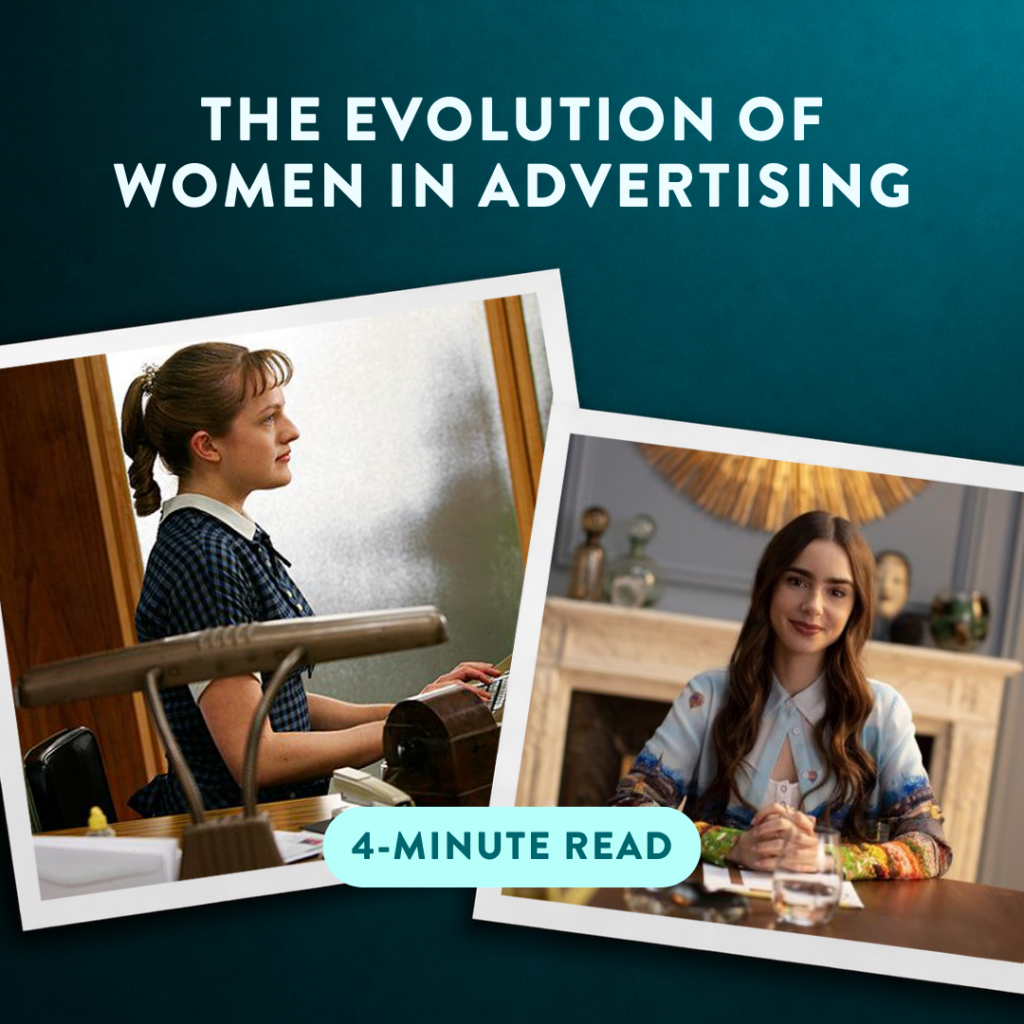
The 2007 drama Mad Men is often referenced as a window into advertising’s past. But in many ways, it made the industry more palatable than it really was.
Peggy Olson’s rise feels inspiring, but it was the exception, not the rule.
For most women, the experience looked very different.
Women were funneled into secretarial and support roles, regardless of ambition or capability, while leadership roles were overwhelmingly held by men. Creative departments were treated like boys’ clubs, where access depended on proximity to male leadership, not merit.
Being objectified, harassed, dismissed, or made uncomfortable was often considered part of the job. Speaking up could cost you your career. Credit for ideas was frequently taken by male counterparts or reassigned. Women were expected to contribute without recognition, to execute without ownership. Pay gaps were standard, and career advancement was frequently blocked by assumptions that women would eventually leave to get married or have children.
Even the work itself reflected this imbalance. Campaigns routinely reduced women to stereotypes, housewives, and side characters because the people creating the work lacked both the perspective and the incentive to do better.
This wasn’t just bias; it was the infrastructure of an entire industry operating on the assumption that women were not the ones shaping culture, just appearing in it.
The Cost of “Making It”
For the few women who did break through, success often came with conditions.
They had to be better, sharper, and more resilient than their male counterparts just to be seen as equals. They were expected to navigate impossible standards, be assertive but not “difficult,” confident but not “intimidating.”
Many learned to adapt to the system rather than challenge it, because pushing back too hard could mean being pushed out entirely.
Burnout was common, and so was attrition.
The industry didn’t just exclude women; it also worked to exhaust the ones who stayed.
Now: Already in the Room, But Not by Accident
Fast forward to today, and the contrast is visible.
In Netflix’s Emily in Paris, the main character is already inside the agency, pitching ideas, shaping campaigns, and influencing brand direction. She’s not asking for permission to be there.
While exaggerated, it reflects something real: women’s presence in advertising is no longer conditional.
But it’s important not to mistake visibility for ease.
Women didn’t simply “gain access.” They forced their way into spaces that resisted them, challenged leadership structures, and pushed for representation in both the work and the workplace.
The room didn’t necessarily open up; it was merely reshaped.
The Real Disruption: Bypassing the Gatekeepers
The most significant shift didn’t happen because agencies became more equitable.
It happened because, for the first time, women didn’t need them.
The rise of the creator economy fundamentally changed who gets to have influence. Platforms like Instagram, TikTok, and YouTube allowed women to build audiences, control their narratives, and monetize their ideas without waiting for approval.
This wasn’t just a new channel but rather a run-around of a system that had historically limited them.
Where agencies once decided who had a voice, creators now do.
Where brands once dictated the message, women now build their own.
For an industry that long controlled access, this shift represents a loss of gatekeeping power as much as a gain in opportunity.
A Shift in the Work, Because the Power Shifted
As women gained influence, the work didn’t just become more inclusive but also more honest.
Representation expanded beyond narrow, idealized versions of womanhood. Stories became more nuanced, more reflective of real experiences, and less filtered through a single perspective.
This didn’t happen because the industry suddenly became more thoughtful, but rather, it happened because the people shaping the work changed.
Advertising has always been a reflection of who holds power. As that power shifts, so does the output.
Progress, Not a Rewrite of History
It’s easy to frame this as a clean evolution, but it isn’t.
The industry still carries many of the same structural issues, just in more subtle forms.
Women are still underrepresented at the highest executive levels. Pay gaps persist. Bias hasn’t disappeared; instead, it’s adapted.
And the creator economy, while opening doors, has introduced new pressures. Constant content demands, algorithm dependency, and the expectation to turn identity into a brand can create a different kind of burnout.
The difference now is visibility.
What was once tolerated in silence is now discussed, challenged, and, increasingly, rejected.
What Comes Next: From Access to Ownership
If the past was about breaking in, the future is about control.
Women are no longer just working within the system. They are building their own agencies, launching brands, leading creative strategy, and redefining how advertising operates.
They are deciding what gets made, how it gets made, and who it’s for.
That shift (from participation to ownership) is where the real transformation is happening.
From Being Managed to Leading the Narrative
This evolution isn’t just about career progression. It’s about power.
Women in advertising have gone from being managed, overlooked, and underestimated to becoming the ones setting direction, shaping culture, and influencing how brands connect with the world.
Where they were once expected to adapt to the industry, they are now forcing the industry to adapt to them.
The future of advertising won’t just include women.
It will be defined by how much control they continue to take.