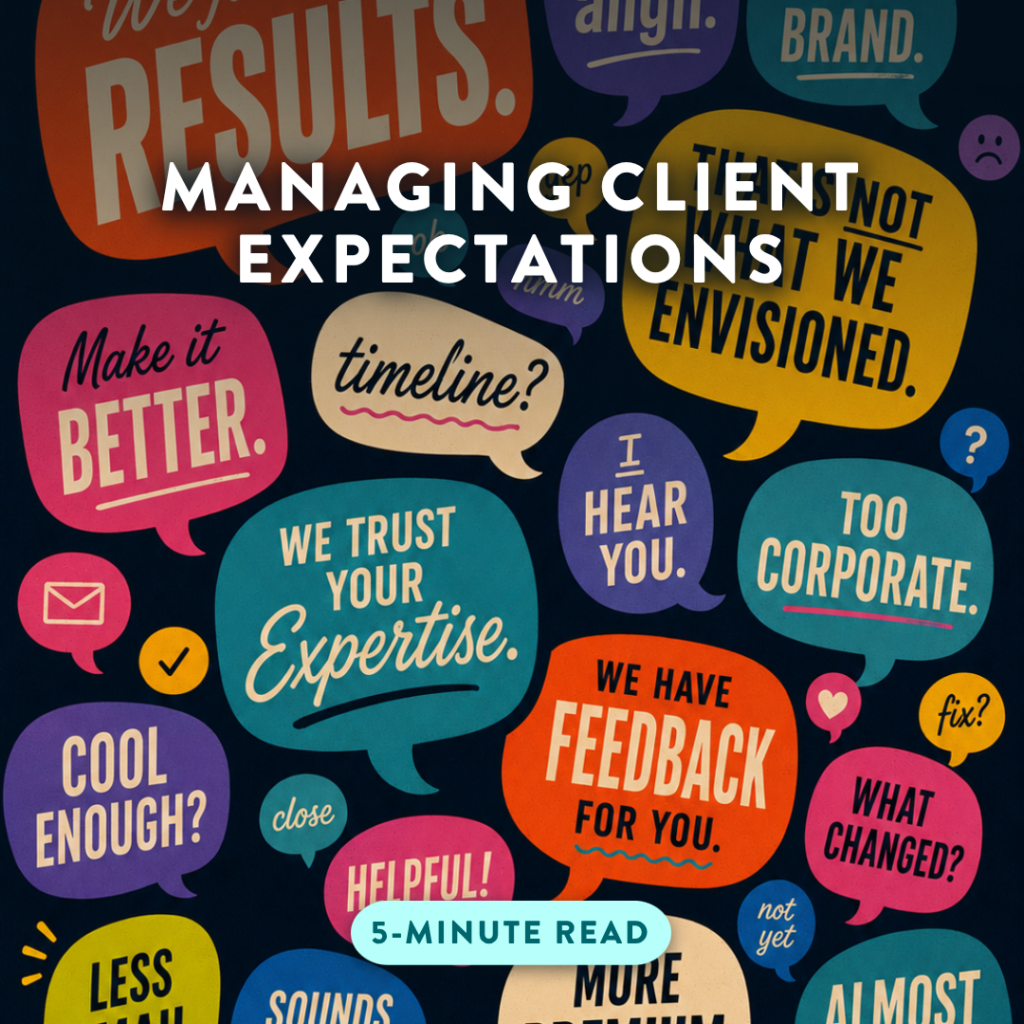

Managing Client Expectations Without Managing the Client
5 Minute Read
There’s an old saying that has been repeated in sales, service, and business for generations:
The client is always right.
It is simple. It is memorable. It also gets complicated pretty quickly.
In a retail setting, the idea makes sense. A customer wants the blue sweater instead of the green one? Great. They want their sandwich without pickles? No problem. Within reason, the goal is to give the customer what they want.
But marketing is not always that straightforward.
When a client hires a marketing team, they are not just paying for a finished product. They are paying for strategy, perspective, creative direction, and experience. They are paying for someone to help them see what they may not be able to see from inside their own business.
And that experience matters.
But experience does not mean having all the answers. It does not mean walking into every project with a clipboard, a whistle, and a “trust us, we know best” attitude. At least, it shouldn’t.
Experience is something you never stop gaining. Every client, every campaign, every challenge, every missed expectation, and every course correction teaches you something. The longer you do this work, the more you realize that expertise is not about being right all the time. It is about knowing how to ask better questions, listen more closely, and recognize when there is more to the story.
Because yes, the client is right. Especially when it comes to their business, their audience, their history, their goals, and their internal pressures.
But sometimes, the agency may be right too.
The real work is figuring out how both things can be true at the same time.
The Client Knows Their Business. You Know Your Craft.
A client may not always use the language a marketer would use. They may say a design is not “cool enough,” a headline does not “feel right,” or a campaign is missing “something.”
Is that vague? Sure.
Is it wrong? Not necessarily.
“Cool” may not be a measurable creative direction, but it is still a real reaction. The job is not to dismiss it, but instead to understand it.
What does “cool” mean to them? More modern? More confident? More premium? Less corporate? More like the brands they admire? Less like the competitor that they are trying to distance themselves from?
That one vague word may be carrying a lot of information. You just have to slow down long enough to unpack it.
It is a little like trying to tune an old radio. At first, all you get is static. But if you keep adjusting, the signal starts to come through.
Expectations Usually Have a Backstory
Sometimes a client asks for something that feels unreasonable.
They want a full campaign turned around in three days. They want another round of revisions after everyone agreed the last round was final. They want to shift direction right when the project feels nearly complete.
It can be frustrating. But before reacting, it helps to ask why.
Maybe they have a board meeting coming up. Maybe their sales team is under pressure. Maybe a competitor just launched something similar. Maybe someone internally changed the priorities and forgot to mention it until now.
That does not mean every request is doable. It does mean the request probably came from somewhere.
When you understand the pressure behind the ask, you can respond with more clarity and less defensiveness.
Instead of saying, “That timeline is impossible,” you can say, “Here is what we can realistically complete by then, and here is what would need more time to do well.”
That is a very different conversation.
Scope Is Not Just a Document. It Is a Shared Understanding.
Setting expectations early matters. Everyone knows that.
Timelines, deliverables, revision rounds, approvals, dependencies, and responsibilities should all be outlined before the work begins. That part is important.
But a scope document alone does not guarantee alignment.
A timeline that says “two weeks” may mean one thing to the agency and another thing to the client. Does that include feedback time? Does it depend on receiving assets? Who needs to approve each stage? What happens if the client’s team takes four days to review something that was expected back in one?
Those details matter.
Because if you promise something will be done in two weeks and it is not, the client will be upset. And if the delay was caused by something outside your control, but you never explained how that dependency affected the schedule, the client is not wrong for being frustrated.
Clear expectations are not just about protecting the agency. They are about protecting the relationship.
When Things Go Wrong, Do Not Skip the Human Part
Projects do not always go perfectly.
A concept misses the mark. A deadline moves. A detail gets misunderstood. A client is unhappy with something you thought was buttoned up.
It happens.
In those moments, it is tempting to jump straight into explanation mode. To defend the work. To point back to the scope. To remind everyone what was approved.
Sometimes those things need to be said.
But usually not first.
First, the client needs to know they have been heard.
This is their company. Their image. Their investment. Their reputation. Their frustration is not an inconvenience; it is part of the responsibility that comes with doing meaningful work for someone else’s brand.
That does not mean absorbing every criticism without boundaries. It means listening before solving.
A calm, honest response can change the entire temperature of the room:
“I hear what you’re saying. Let’s walk through where this is feeling off and figure out what needs to change.”
That one sentence can do more than a 12-slide defense deck. Very “less PowerPoint, more actual point.”
Walk Back Down the Ladder
There is a useful decision-making concept called the Ladder of Inference, commonly associated with Chris Argyris and later popularized by Peter Senge in The Fifth Discipline. The model explains how people move quickly from observable facts to assumptions, conclusions, and actions, often without realizing it.
In client work, this happens all the time.
The client sees a design and thinks, “This is not what I asked for.”
The agency thinks, “This is exactly what we agreed to.”
Now both sides are standing on different rungs of the ladder, trying to hand each other the same object and getting annoyed that it is not working.
The client may be reacting to an expectation they never fully explained. The agency may be reacting to a scope that they thought was fully understood.
Both sides may be operating in good faith. They are just not standing in the same place.
The solution is to walk back down the ladder.
What did the client expect to see?
What did the agency believe it was delivering?
Where did the meaning shift?
What was assumed but never said out loud?
Once you get back to the same rung, you can move forward together.
Some Conversations Should Not Start in Email
Managing expectations is not just about what you say. It is also about how you say it.
Email has its place. It is useful for recaps, approvals, timelines, next steps, and documentation. But when a conversation is tense, unclear, or emotionally loaded, email can make things worse before anyone realizes it.
A sentence meant to be direct can read as cold. A quick reply can feel dismissive. A simple question can sound like a challenge. Depending on the reader’s mindset, expectations, or stress level, the same email can land five different ways.
Suddenly, everyone is responding to a tone that may or may not have been there in the first place.
Whenever possible, sensitive conversations are better handled face-to-face, or at least voice-to-voice. In person, you can hear tone, ask follow-up questions, read the room, and correct misunderstandings before they grow legs and start running around like a rogue Roomba.
And, yes, there is the tiny added bonus that not every awkward sentence has to live forever in someone’s inbox like a digital fossil from 2007.
That does not mean avoiding written communication. It means using the right tool for the right moment. Talk through the sensitive stuff first, then follow up in writing with what was decided. That keeps the relationship human and the project accountable.
The Client May Be Right. You May Be Too.
Managing client expectations is not about proving who knows more.
It is about listening closely enough to understand what is really being said. It is about setting expectations clearly enough that no one has to guess. It is about responding to tension with curiosity before defensiveness.
The client is always right in the sense that their perspective matters.
Your expertise is right in the sense that it should guide the work.
The sweet spot is where those two truths meet.
That is where the best marketing happens.