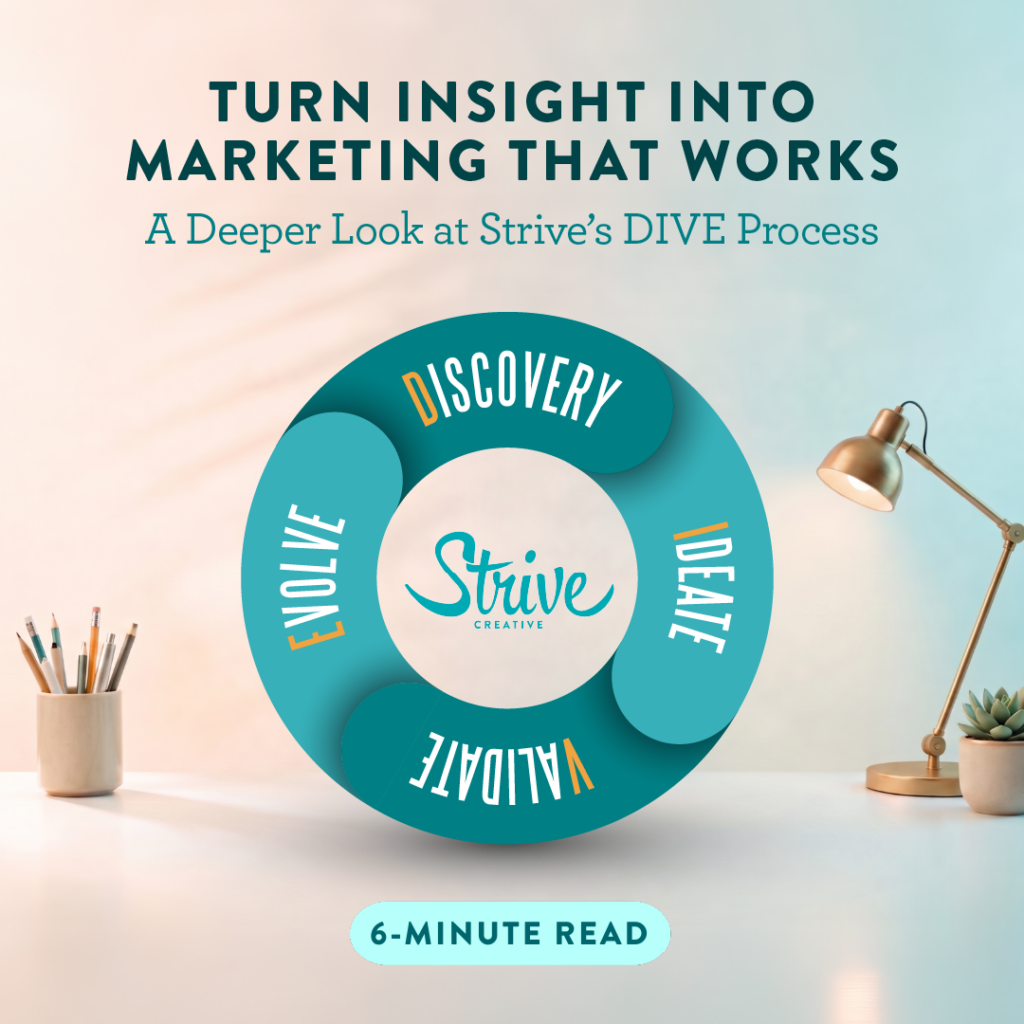

Turn Insight Into Marketing That Works
4 Minute Read
A Deeper Look at Strive’s DIVE Process
Good marketing should look effortless.
That is part of the magic.
The campaign feels clear. The message lands. The design makes sense. The audience understands what to do next. The strategy, content, visuals, and execution all feel connected. Everything appears polished, intentional, and maybe even a little obvious in hindsight.
But effective marketing does not usually start that way.
Behind the scenes, there are questions, research, conversations, rough ideas, wrong turns, second drafts, better questions, sharper insights, and plenty of “almost, but not quite.”
At Strive, we use our DIVE process to bring structure to that journey.
DIVE stands for Discover, Ideate, Validate, and Evolve. It is how we move from understanding the problem to building thoughtful strategies, campaigns, content, and creative solutions that actually serve the brand, the audience, and the goal.
Because marketing is not just about making something look good.
It is about making something work.
Discover: Start by Understanding What Matters
Every strong marketing effort begins with discovery.
Before we jump into strategy, messaging, design, content, media, or campaign ideas, we need to understand the landscape. Who is the audience? What does the brand stand for? What problem are we solving? What has worked before? What has not? What does success actually look like?
This stage is about listening, asking, observing, and learning.
Sometimes discovery confirms what everyone already suspected. Other times, it reveals something new. A customer insight. A gap in the market. A disconnect between how a brand sees itself and how the audience experiences it. A missed opportunity in the messaging. A channel that is underperforming for reasons no one has fully unpacked yet.
Skipping discovery can feel faster, but it often leads to strategies built on assumptions. And assumptions have a funny way of showing up later, usually right when a project is supposed to be wrapping up.
Kind of like realizing you forgot to rewind the VHS before returning it. The problem was there all along. You just did not deal with it early enough.
Discovery helps us get honest about where we are starting, so we can make smarter decisions about where we are going.
Ideate: Turn Insight Into Possibility
Once we understand the challenge, we move into ideation.
Ideation is not just about throwing random concepts at the wall and hoping something sticks. It is a focused process grounded in what we learned during discovery. The goal is to explore possibilities while staying connected to the bigger marketing objective.
What message will resonate? What story should we tell? Which channels make sense? What kind of content will support the customer journey? What visual direction supports the brand? What campaign approach will help the audience care, click, remember, respond, or take action?
This stage is where curiosity and discipline have to work together.
There is room for big thinking, unexpected angles, and creative exploration. But there is also a filter. The best idea is not always the loudest, trendiest, or flashiest. It is the idea that connects most clearly to the objective.
Sometimes that means pushing into bold territory. Sometimes it means simplifying. Sometimes it means choosing a more strategic channel mix instead of trying to be everywhere at once. Sometimes it means resisting the urge to add one more thing, even though the marketing brain is whispering, “But what if we made it pop?”
Ideation gives us space to think widely before narrowing in on the strongest path forward.
Validate: Get the Work Out of Its Own Bubble
A strategy can feel strong in an internal meeting. A campaign can look great on screen. A message can sound clear to the people who have been living with it for weeks. But that does not always mean it will land the same way with the audience. So we look outside the team.
That might mean sharing the work with others at Strive, gathering feedback from the client’s team, running a focus group, testing two versions of a message, or using performance data to see what people actually respond to.
The goal is not to chase every opinion. The goal is to make the work stronger.
Validation helps us pressure-test the strategy, message, creative direction, and execution before we move too far down the road. Does it support the goal? Fit the audience? Reflect the brand? Work in the channel? Move people closer to action?
Those questions keep the conversation focused on whether the work is doing its job, not just whether someone likes it.
Instinct still matters. But instinct gets better when it is challenged, sharpened, and backed by insight from outside the room.
Evolve: Keep Improving What Works
The work does not stop once something launches, publishes, prints, posts, or goes live.
Brands change. Audiences shift. Platforms update. Priorities move. Competitors adjust. What worked six months ago may need to be refined today. What started as a strong strategy may become even stronger after seeing how people respond to it.
Sometimes evolution means refining a message. Sometimes it means adjusting a campaign. Sometimes it means changing the channel mix. Sometimes it means expanding content around what is resonating. Sometimes it means pivoting based on performance. Sometimes it means recognizing that a brand has grown and the marketing needs to grow with it.
This stage is rooted in a simple belief: good work should keep getting better.
Experience is part of that, too. The longer you do this work, the more you realize that marketing is never really finished. Every project teaches you something. Every client brings a new perspective. Every result gives you information you did not have before.
Why the Process Matters
Process does not need to be complicated to be useful.
In fact, that is the point.
DIVE gives us a simple framework we can repeat, adjust, and build from. It keeps the work moving without letting us skip the steps that matter. It helps us stay focused, ask the right questions, and make better decisions at each stage.
Because good marketing does not happen by accident.
It happens when there is enough structure to keep everyone aligned and enough flexibility to adapt when the work calls for it.
That is the heart of DIVE.
And that is how thoughtful strategy becomes effective marketing.