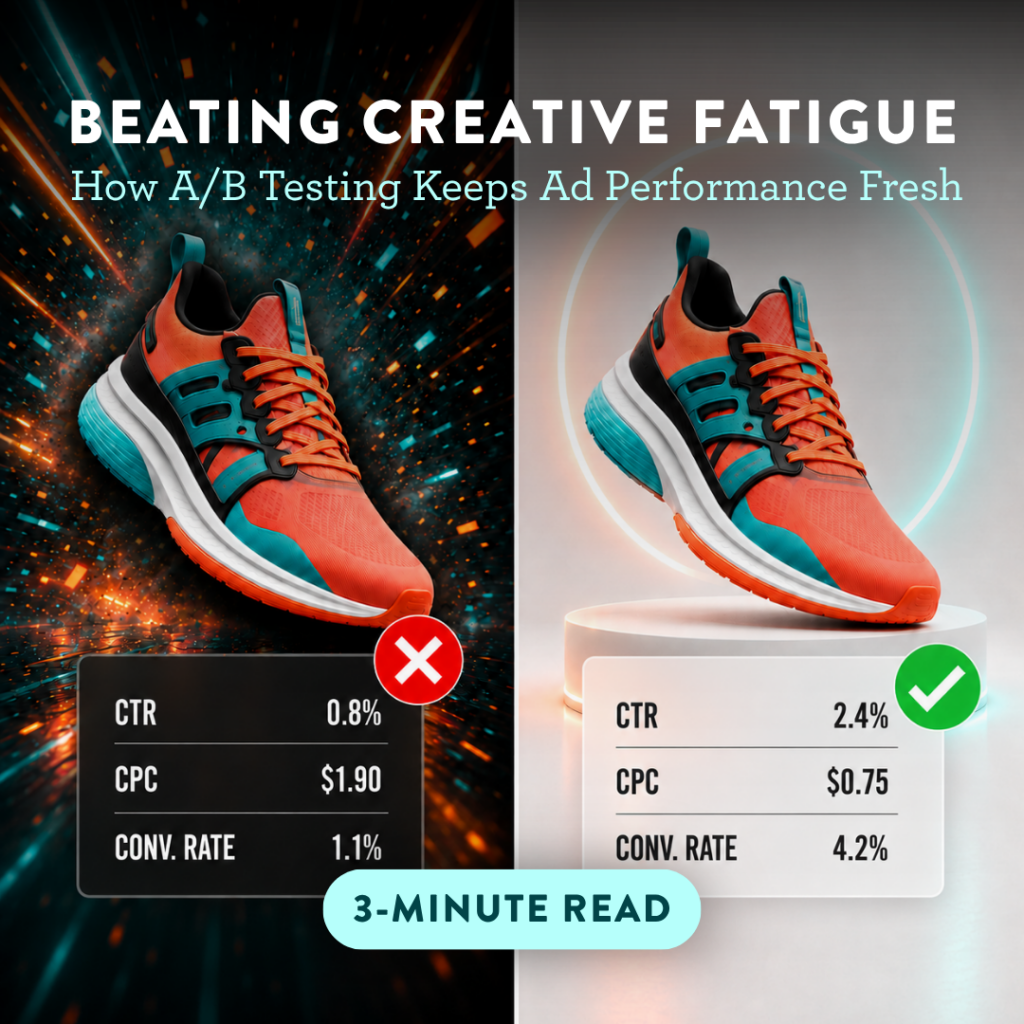

Beating Creative Fatigue: How A/B Testing Keeps Ad Performance Fresh
3 Minute Read
You’ve run the test, found your winner, and the campaign is performing. If only that were the finish line. Even the strongest creative has a shelf life, and the same A/B testing process that got you to a winning ad is what keeps it winning once the audience starts to tune it out.
When Your Favorite Creative Falls Flat
Sometimes the underperformer isn’t a fatigued veteran. It’s the new concept you were sure would be the stronger play: on-brand, on-message, visually strong, and it still lands flat once it’s live, while the “safe” backup pulls a better click-through rate or a lower cost-per-conversion. Results like this are the reminder that a pivot needs its own test, not just a confident swap.
Signs Fatigue Is Setting In
As the same creative runs across a digital platform, the audience starts to tune it out, and performance metrics reflect it: CTR softens, frequency climbs, cost-per-click creeps up, and conversion rates slide even though targeting hasn’t changed. That’s creative fatigue, and it’s less about the ad being wrong and more about it simply having run its course.
The fix isn’t to panic and pull the campaign. It’s to have a fresh variation ready to test the moment the data signals fatigue, so the transition from “winning creative” to “next creative” is seamless instead of reactive.
The Pivot: Testing Your Way to a Comeback
This is where A/B testing becomes less of a launch checklist and more of an ongoing habit. When a top-performing creative starts to dip, the smartest move is to introduce a new variant built on what the last test already taught you, not a total fresh start. If informational messaging outperformed emotional messaging last round, test a new informational angle rather than reverting to what already lost. If a product-in-use visual beat an isolated product shot, explore a different product-in-use scenario before abandoning that direction entirely.
This is also where a strong design process pays off: having a pipeline of on-brand creative variations ready to go means a pivot takes days, not weeks, and performance dips get caught before they cost real budget.
We’ve seen this play out directly with clients. For one, the test was that a more lifestyle-focused creative would outperform a straightforward product shot. The test said otherwise: viewers responded far more strongly to the product-only version. Rather than stopping there, we kept testing within that winning direction, trying different product colors to see which resonated most, and used those results to inform the next round of creative. The lesson wasn’t “the fancier concept wins.” It was “let the pivot follow the data, even when it contradicts the initial hypothesis.”
Building a Testing Habit, Not a One-Time Fix
The biggest shift for marketers to make is treating A/B testing as a continuous cycle rather than a single event tied to a campaign launch. Fatigue is inevitable. It happens sooner than we wish. Hypotheses will occasionally be wrong. The advantage goes to the teams that expect both and have a testing rhythm already in motion to respond, rather than scrambling to figure out why performance suddenly dropped and needing to brainstorm for their next move.
Set a cadence for reviewing creative performance, keep a bench of tested alternatives ready, and let the data decide what runs next. That’s how A/B testing moves from a growth tactic into a genuine competitive edge.
Whether you’re setting up your first test or trying to figure out why a once-strong campaign has gone quiet, having a partner who lives in this data every day makes the difference. Reach out to Strive and let’s build a testing strategy that keeps your creative performing beyond launch.