
Strategy Over Slop: What AI Really Changed for Creatives
4 Minute Read
Part of our Marketing Misconceptions series, where we tackle the assumptions that quietly sabotage good marketing decisions.
Overview
The debate about AI in creative has shifted from what it can do to whether we should. Now it’s about “AI slop,” taste, and whether audiences even trust what they’re looking at anymore. What’s worth getting right is how you approach it all.
AI has a real place in our process, and every tool in it earned its spot. We’re discerning about what makes the cut: it has to deliver quality work, genuinely save us time, not pose an ethical risk, and produce something we’re confident is our own original idea, worth putting in front of a client. Using it well starts with being clear about what it actually changes and clearing up a few misconceptions that keep getting in the way.
Misconception #1: “AI levels the playing field.”
The pitch is seductive: type a prompt, get pro-level work, and suddenly skill matters less. Anyone can make anything.
It hasn’t worked out that way. AI is a magnifier, not an equalizer. Point it at a sharp concept, and it produces sharp work faster. Point it at a shallow one, and it produces high-fidelity shallowness, polished enough to look finished and empty enough to feel like nothing. Most “slop” isn’t a tool problem: it’s a direction problem. AI is quietly sorting creatives into two groups: the ones who can drive it, holding a point of view and keeping firm control of the output, and the ones who let it drive them. The gap between strong and weak work isn’t closing. It’s widening.
Here’s the shift worth sitting with. When AI takes the repetitive tasks off your plate, use the time it frees up well. Making more is part of it, but the bigger win is pouring those hours back into deeper thinking, strategy, and concept, because that’s where the value now lives. And just because you can generate a cool-looking image in ten seconds doesn’t mean you should, especially when it isn’t grounded in a strategy.
Misconception #2: “AI does the creative work.”
The assumption here is that you hit go and the tool designs it for you. Creativity, automated.
The more useful framing is acceleration, not automation. The creative decisions still belong to a person: the concept, the composition, the styling, the sense of what a piece is even for. AI earns its place further down the line, handling the non-creative execution that used to eat the hours.
That’s worth separating into two very different categories. Targeted AI tools built to do specific things (many of them built right into software we already use) are one thing. Broad, prompt-it-from-scratch content generation is another. In Photoshop, Generative Expand can pull more sky out of a photo so a horizontal shot works as a vertical story, and smarter selections turn a mask that used to take 30 to 45 minutes into a two- or three-minute job. The same is true in the edit bay: DaVinci Resolve’s Magic Mask isolates a subject in a few clicks instead of frame-by-frame rotoscoping, and sky replacement swaps a flat gray sky for a better one without a reshoot. Anyone who retouched images or rotoscoped by hand before these tools existed knows the time saved is enormous. But every one of them supports a decision a human has already made. They speed up the grunt work without touching the idea.
The second category is where people overestimate AI, and it shows most in motion work. Ask it to edit, and it falls apart, because editing runs on subtlety and rhythm it doesn’t have. It can generate infinite possibilities but can’t decide which one means anything. When production friction disappears, art direction matters more, not less. Adoption of AI tools across creative work is now nearly universal, yet the vast majority of businesses say it hasn’t reduced their need for creative talent. What changed is the speed at which good decisions come to life, not who’s making them.
Misconception #3: “AI content is fine to use anywhere.”
If it looks good, ship it. That’s where the most avoidable damage happens.
Context decides. According to Getty Images’ “Building Trust in the Age of AI” report, roughly 90% of consumers want to know whether an image was made with AI, 98% say authentic images and video are pivotal to trusting a brand, and 76% admit they can’t reliably tell what’s real anymore. People react worse to AI-generated people and products than to AI-generated backgrounds. Content that reads as machine-made carries a trust penalty that no amount of polish removes.
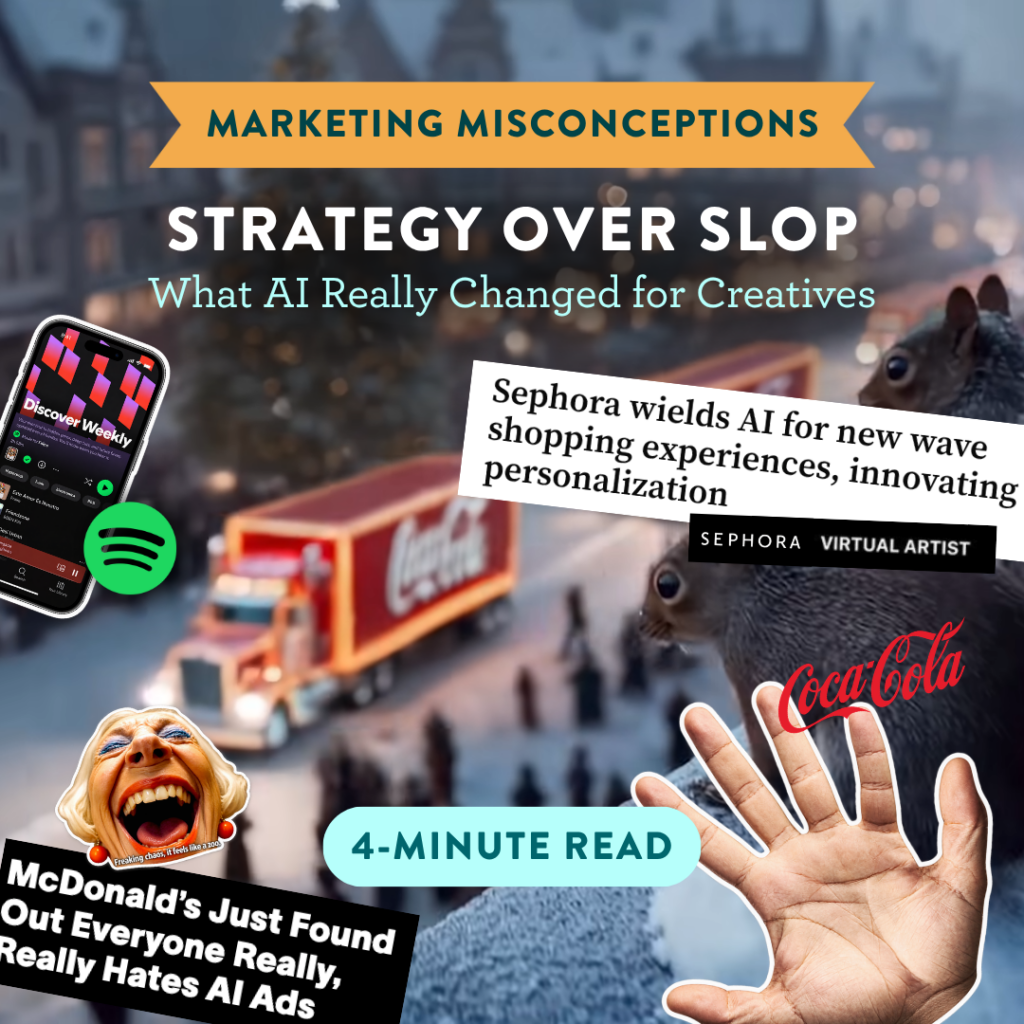
There’s a version of AI use that makes work better and one that makes it hollow, and audiences can tell them apart instantly. The hollow version treats AI as the idea, like Coca-Cola’s AI-generated holiday ads that looked slick at a glance but were unmistakably AI, full of tells and errors, and emotionally hollow — a familiar stumble, since longtime readers know we have thoughts on Coke and AI. The useful version treats it as invisible infrastructure, like Spotify’s Discover Weekly or Sephora’s Virtual Artist: tools people happily use because they make life easier and never pretend to be something they’re not. The test is one question: are we using AI to execute an idea better, or using it as the idea?
So our line is simple. Human-directed craft goes into everything we make, no matter where it ends up. The difference is the degree. The more internal or fast-moving the work, the more we trust AI to carry it — whether that’s iterating on social content, generating ideas, or organizing a project. The more public-facing and permanent it is, the more human oversight it calls for. We know where that line sits, and we choose the right tool for the job, or no tool at all. That judgment is where client trust is either built or quietly spent.
The 2026 Mindset
The question was never really “Can AI make this?” It almost always can. The better question is “What decisions still have to be ours?”
AI made everyone faster at the same time. Now that everyone can move fast, speed alone no longer makes work stand out. The thinking behind it does. Whatever launches next quarter — and something will — that won’t change. Knowing why something deserves to exist at all stays stubbornly, valuably human.