
Twenty-Two Years In
3 Minute Read
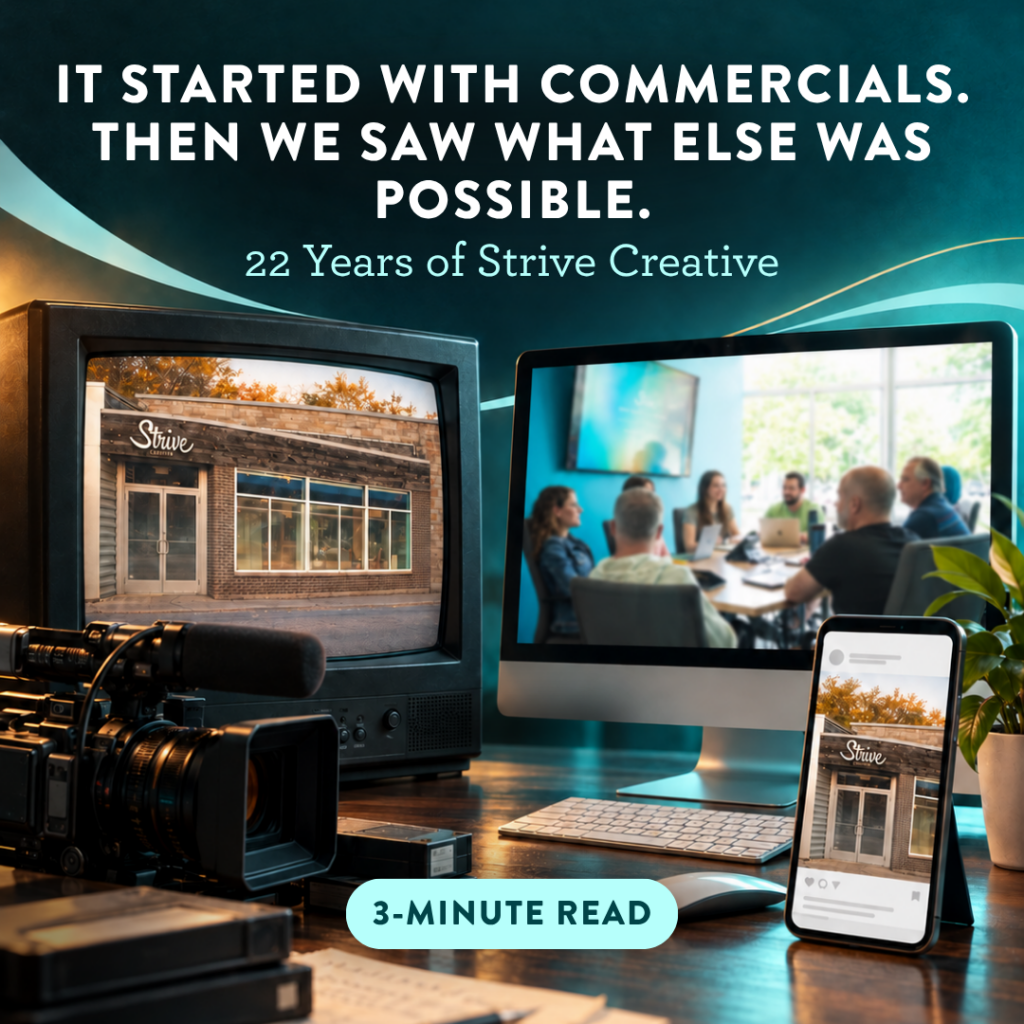
Strive started in 2005 as a video production company. We made commercials. That was the business, and we were good at it.
What changed the company wasn’t a new service line. It was realizing the commercial was rarely the whole problem.
What we started noticing
When you work closely with a client on a spot, you see the rest of their operation whether you mean to or not. We’d finish a piece of work we were proud of and watch it run against a website that undercut it, or send traffic to a page that had no idea what to do with it.
Nobody was asking us to fix those things. The production company handles production, and that’s where the relationship ends. But our clients were being served pieces by vendors who each had a narrow view, and the pieces weren’t adding up.
So we built out. Design. Web development. Digital advertising. Media planning. Analytics. Not to have a longer list of services, but because we couldn’t do right by a client while owning one slice of what determined whether their marketing worked.
Our name says Creative. The work starts before that.
The clearest version of that gap showed up in media.
Once we were far enough into campaigns to see how buys were being made, we found there often wasn’t a strategy underneath them. Plans were built on availability, rate cards, and whatever ran last year. Nobody could explain what job a given tactic was supposed to do, which meant nobody could say whether it had done it.
That’s the hole we built into. Every piece of work we produce now maps to a stage in the customer journey: awareness, engagement, or conversion. That framework is how we plan a campaign and how we grade it afterward, so a buy built for reach isn’t judged against a search campaign built to close. When something underperforms, we isolate the cause instead of guessing at it, then test against it.
None of that is creative work. It’s what makes the creative worth paying for. A great spot aimed at the wrong audience at the wrong stage of the funnel is an expensive piece of film.
What that changed about how we sell
An agency that only sells video has to see every problem as a video problem. Same with SEO shops, same with media buyers. The recommendation is decided before anyone walks in the room.
We’d rather start further back. Where are you losing people? What’s working that you haven’t funded properly? What are you paying for that isn’t doing anything? Those questions are only worth asking if you’re willing to hear an answer that doesn’t put your best service on the invoice.
That’s what we mean by Think First. Question before you craft. It only holds up if you’re not financially attached to one answer.
Two clients that stretched us
Metro Detroit Chevy Dealers moved us into a different weight class. Media at that scale demands rigor that smaller budgets let you skip, and a willingness to say out loud when spend is sitting in the wrong place. Much of how we evaluate performance today came out of that account.
Jet’s Pizza taught us the franchise model. A national brand on one side, franchisees thinking about their own store and their own market on the other. Building work that keeps the brand consistent while still landing locally made us better at every client with more than one stakeholder, which is most of them.
We didn’t add those capabilities and then find accounts that needed them. We grew into the accounts.
Where we are now
AI is where that’s playing out now.
We’re not using it to replace the people doing the work. We’re using it to take the drag out of their day, building tools that handle the slow parts: pulling insight out of client data, turning research into something usable, getting from strategy to execution without weeks of production overhead.
The payoff is practical. We understand a client’s situation faster. We implement quicker. And because the cost of producing the work came down while the quality of the thinking went up, we can often do more for less. That’s the same thing we’ve been after since 2005: work that holds up against the big shops without the invoice that usually comes with it.
The judgment still has to be human. Knowing which question to ask, hearing what a client isn’t saying, recognizing when the obvious answer is wrong. No model does that.
Twenty-two years
The constant isn’t how much we’ve added. It’s that every step came from seeing a gap between what a client was getting and what they needed, and deciding to close it ourselves rather than stay in our lane.
Video to full-service. Instinct to measurement. Small campaigns to serious media. Single brands to franchise systems. Traditional production to AI-assisted everything.
We don’t know what the next one looks like. We know it’ll start the same way.
To everyone who’s trusted us with their brand over these twenty-two years, thank you. You built this alongside us.
We still start every relationship the same way, with a real conversation about what’s actually in the way. If you want to have one, let’s talk.
Josh Robinson & Wade Callahan, Co-Founders, Strive Creative