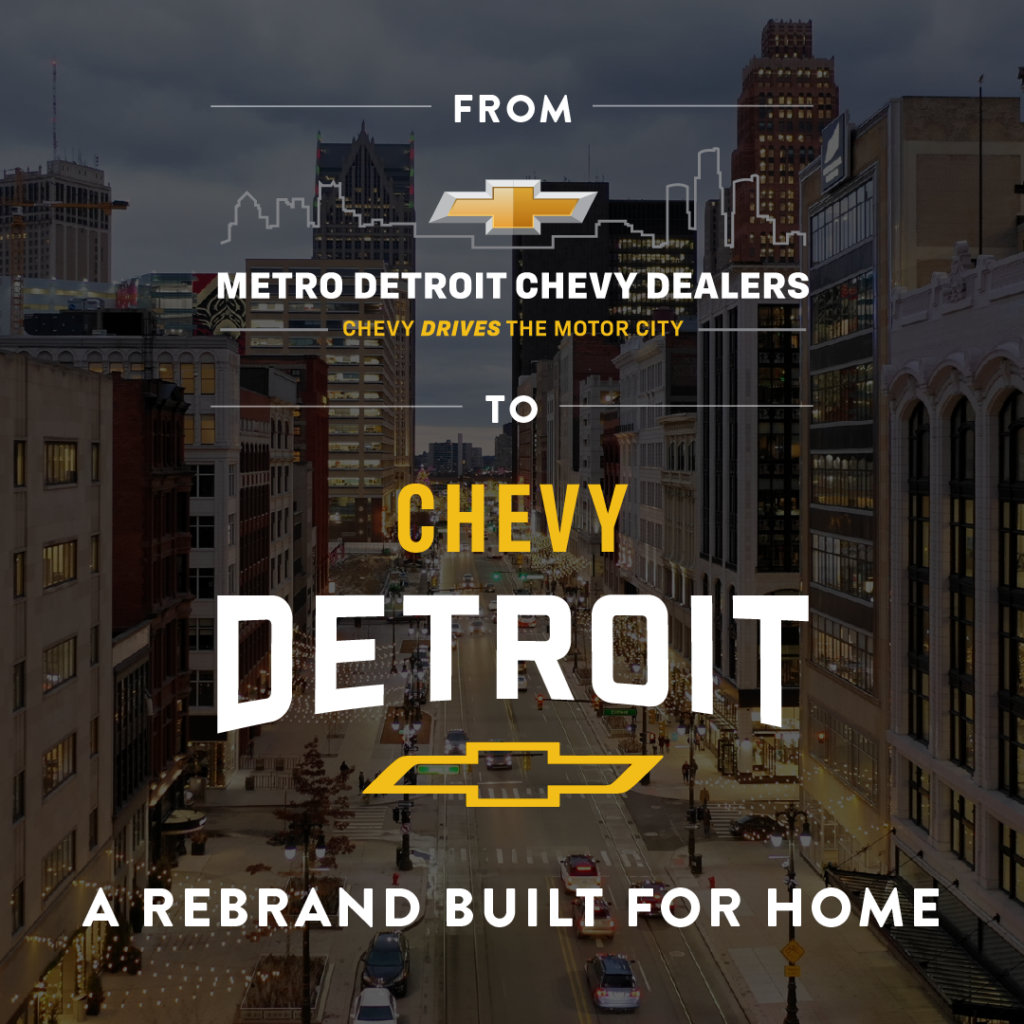

From “Metro Detroit Chevy Dealers” to “Chevy Detroit”: A Rebrand Built for Home
5 Minute Read
Chevrolet’s history has always been larger than sheet metal.
For more than a century, the brand has been woven into the American story: road trips, Friday-night lights, “work hard, play harder,” and that unforgettable, deeply ingrained-in-your-brain jingle: “Baseball, hot dogs, apple pie, and Chevrolet.” It’s the kind of cultural shorthand that feels like it came pre-installed in the country’s operating system.
So when we began working with the Metro Detroit Chevy Dealers in 2010, we weren’t starting from scratch. We were starting from something powerful.
But we were also starting at a moment when “powerful” and “popular” weren’t the same thing.
The context in 2010: Chevrolet had history, but public trust was bruised
In the wake of the financial crisis and auto industry collapse, General Motors went through a government-supported restructuring and filed for Chapter 11 bankruptcy on June 1, 2009; emerging about 40 days later, in July 2009.
The headlines were loud, and the public’s feelings were louder.
The U.S. Treasury invested tens of billions into GM during that period (Treasury’s own releases cite $49.5B invested in GM, with returns and a remaining stake detailed after the company’s post-bankruptcy turnaround).
Whether you call it a bailout, a rescue, a lifeline, or a necessary economic fire extinguisher, one thing was clear: a lot of people weren’t thrilled about their tax dollars being connected to a publicly traded automaker. And because consumers don’t separate corporate structures the way spreadsheets do, that skepticism didn’t stop at GM corporate; it splashed onto the brand and, by association, onto local dealers.
Which meant our challenge wasn’t simply “make great ads.”
It was bigger and more human than that.
The real assignment: Make the Chevy dealers feel like neighbors, not a logo
We were tasked with helping the Metro Detroit Chevy Dealers show something the market wasn’t automatically giving them in 2010:
That they were more than the bowtie.
That they lived here, worked here, raised families here, and rooted for the same teams and neighborhoods as the people walking into their showrooms. That they weren’t a faceless corporation; they were Metro Detroit.
At the time, the brand identity leaned heavily on the official name—Metro Detroit Chevy Dealers—paired with the tagline “Chevy Drives the Motor City.”
The intent was right. The execution had a challenge: it still felt like it was trying to prove it belonged.
So we asked a simple question that would guide years of work:
If we truly believe the dealers are part of the community…why aren’t we showing the community?
Flipping the script on car advertising: Detroit as the hero shot
Back then, a lot of car commercials had a familiar formula: sweeping mountain passes, sun-drenched coastal highways, desert switchbacks, anonymous skylines. Beautiful, sure. Also: completely unrelated to how most people in Detroit actually live.
And when Detroit did show up in advertising, it was often framed through the most tired lens possible: abandoned buildings, hardship porn, and the kind of imagery that says, “Look how gritty this is,” without ever saying, “Look how alive this is.”
We flipped that.
Instead of borrowing someone else’s backdrop, we chose to put Chevy vehicles in and around Metro Detroit, not as a “setting,” but as a statement.
We showed off what locals already knew: the energy and architecture, the neighborhoods and main streets, the people building things, making music, opening doors, and taking risks, and the local businesses that give the city its heartbeat.
We featured local talent. Local businesses. Local musicians.
It wasn’t just a production strategy, but a brand strategy. And the message was consistent:
This is not a brand flying in for a quick photo shoot.
This is a brand that’s been here.
This is a brand that cares about what you care about. And the truth is, it wasn’t just a marketing ploy; the Chevy Dealers did feel that way.
The community-first approach became the brand’s real differentiator
Over time, the work expanded beyond “make Detroit visible” into something deeper: make Detroit central.
The dealers understood that their relationship with the market couldn’t be transactional. This wasn’t about pushing inventory. It was about showing up, again and again, as a participant in the community’s momentum.
That consistent community focus did something important: it created earned familiarity. The kind you don’t get from shouting louder, but from being present longer.
And then we ran into the one thing we couldn’t out-create forever:
The name.
The problem we couldn’t ignore: “Metro Detroit Chevy Dealers” is a mouthful
It’s not that the name was wrong. It was that it was doing too much.
“Metro Detroit Chevy Dealers” is long, easy to scramble, and hard to repeat naturally in conversation. People would constantly remix it into variations like “Chevy Metro Dealers,” “Detroit Metro Chevy Dealers,” or “Metro Chevrolet Dealers”—something close, but not quite.
And when your audience can’t say your name, they can’t carry it. They can’t recommend it. They can’t search it confidently. They can’t turn it into a chant, a hat, a hashtag, or a phrase.
More importantly, the name sounded corporate, like a committee approved it in a windowless room. Meanwhile, everything else we were building was human, local, and proud.
So we decided to do what Detroit has always done best:
Strip it down. Make it real. Make it earned.
The solution: Chevy Detroit
Chevy Detroit is simple to say and hard to forget.
It also aligns cleanly with the digital experience—chevydetroit.com—so the brand name people hear is the brand name they can type.
But the bigger win isn’t convenience.
Its identity.
Chevy Detroit doesn’t sound like an organization. It sounds like a presence. Like it belongs here—like it’s part of the fabric, not just a sponsor on the sidelines.
And culturally, it fits the way Detroit brands itself.
Over the years, the city has rallied around phrases that feel like street-level truth; statements you’d actually hear, actually wear, actually believe. “Detroit Hustles Harder,” for example, became a widely recognized symbol of local pride through the late 2000s and beyond. And “Detroit vs. Everybody” emerged as both a wearable declaration and a cultural calling card.
Chevy Detroit fits that lineage, not by copying it, but by understanding the same underlying rule:
If it doesn’t sound like something a real person would say, it won’t live in the real world.
The logo: Built to look like it belongs here
A name alone doesn’t do the work. The visuals have to carry the same truth.
The original mark leaned on geography and a tagline to explain the concept, but the new identity doesn’t need to over-explain: it’s cleaner, bolder, and more at home on the things that matter now, from social content and merch to video, community presence, and even the kind of hats you spot at the grocery store and immediately think, I need one of those.
That’s a key test of modern branding: not “does it look good on a billboard,” but “does it look good on a person.”
Because when people choose to wear your brand, it stops being advertising and starts being belonging.
Why it’s resonating: It sounds like Detroit, and it acts like Detroit
Rebrands fail when they’re cosmetic. When it’s just a new coat of paint on the same old story.
This one works because the story was already true.
We didn’t invent community. We amplified it.
We didn’t fake authenticity. We committed to it.
We didn’t “borrow” Detroit. We stayed in it.
Chevy Detroit is the name that finally matches what the brand has been practicing for years.
And the best part is what happens next: when the name becomes easy to say, it becomes easy to share. When it becomes easy to share, it becomes a piece of culture: small at first, then suddenly everywhere.
So if you see one of those hats around town and catch yourself thinking, man, where can I get one of those…
That’s not an accident.
That’s the feeling of a brand finally being called what it’s always been.