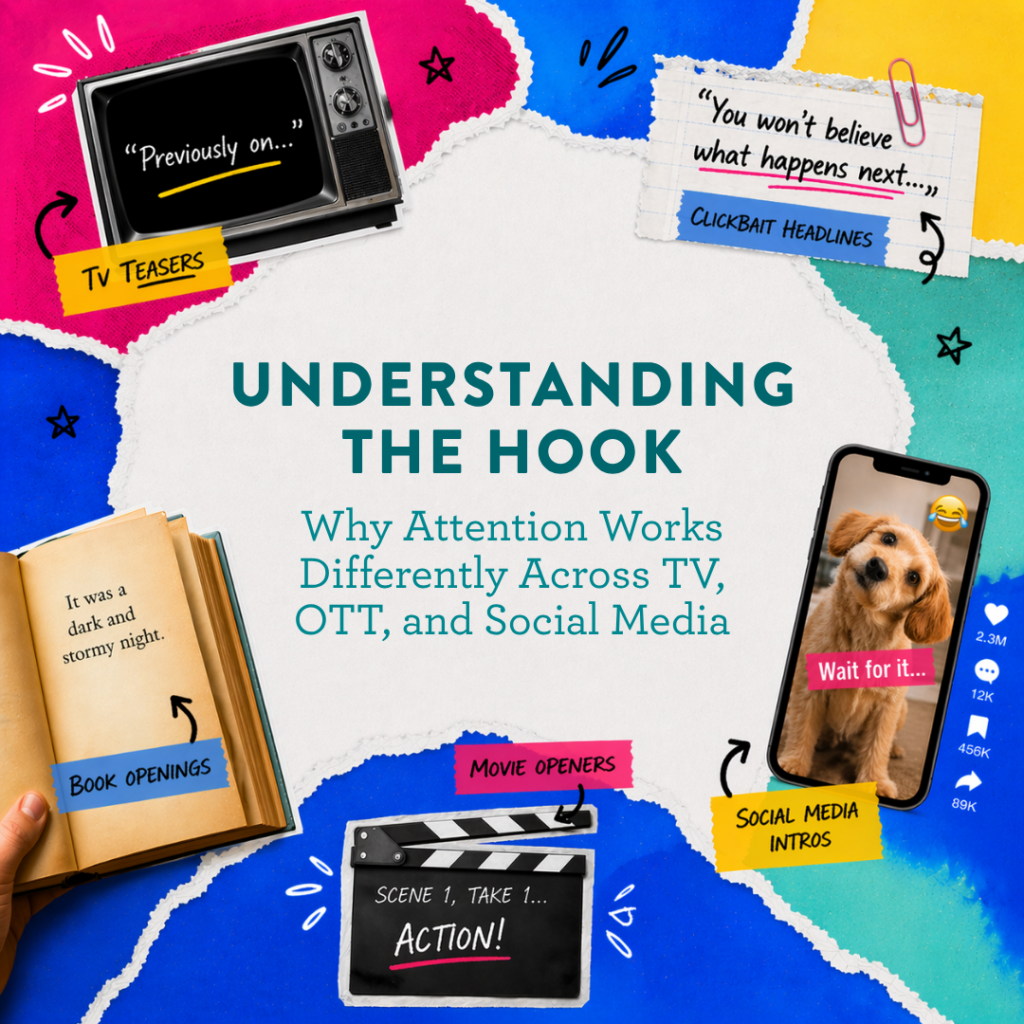

Understanding the Hook: Why attention works differently across TV, OTT, and social media
5 Minute Read
TLDR:
A hook is the part of a message that gets people to pay attention, but the way that the hook works depends heavily on where the message appears. What feels effective in traditional advertising doesn’t always translate to social media, because each channel shapes audience expectations differently.
- A hook is not just a catchy line. It’s the opening moment that creates interest and earns the next few seconds.
- Traditional marketing often uses urgency-based hooks because channels like TV, radio, direct mail, and OTT are built around interruption.
- On TV, hooks can also be more creative and layered, using hidden messages, subtle visual details, or in-the-know references that reward attention.
- Social media changes the equation because people are not there to be sold to directly. They’re scrolling quickly and deciding almost instantly what feels worth their time.
- That means a hook is not universally good or bad. Its effectiveness depends on the platform, the audience mindset, and the context.
Bottom line: The hook still matters everywhere. The difference is that each channel calls for a different kind of opening move.
Why What Works on TV Can Miss on Social
A hook is one of the most important tools in marketing.
It’s the opening move that makes someone pay attention. It’s the line, image, idea, or moment that creates enough interest for a person to keep watching, reading, listening, or engaging. Without it, even a strong message can get ignored. With it, a brand has a chance to break through the noise.
But not all hooks work the same way.
That is where marketers can get into trouble.
A hook that performs well in one channel can fall flat in another. A tactic that feels persuasive in a TV spot may feel awkward in a social post. A message built for interruption does not always translate well to a space built for interaction.
That doesn’t mean the hook matters less; it just means context matters more.
What a Hook Really Does
When people hear the word “hook,” they often think of a catchy headline or a clever first sentence. That can be part of it, but a hook does more than sound good.
A hook creates momentum.
It gives the audience a reason to stay with the message. Sometimes that reason is urgency. Sometimes it’s curiosity. Sometimes it’s emotion, recognition, or surprise. Whatever form the hook takes, the purpose is the same: earn attention quickly enough for the rest of the message to land.
In that sense, every channel needs a hook.
The difference is that each channel trains the audience to respond to different kinds of hooks.
Traditional Marketing Was Built for Interruption
Traditional advertising has long operated on interruption.
A television commercial cuts into programming. A radio spot breaks into a segment. A direct mail piece lands in the stack. An OTT ad appears before or during content someone intended to watch for another reason. In all of those formats, the audience expects some level of persuasion. They know they are being marketed to.
That’s one reason urgency works so well in traditional media.
“Act now.”
“Limited time only.”
“Offer ends soon.”
“While supplies last.”
These hooks are direct, transactional, and efficient. They don’t pretend to be anything else. They tell the audience what matters and why it matters now.
And in the right context, that still works.
Traditional media gives marketers room to be more overt because the relationship between ad and audience is clearer. The ad is making its case. The audience understands the exchange.
But even in traditional media, not every effective hook has to be loud.
Creative Hooks on TV: Hidden Messages and In-the-Know Nods
Television has always made room for a different kind of hook, too, one based less on pressure and more on intrigue.
Some of the most effective TV hooks are subtle. They reward attention instead of demanding it.
A background detail. A line of dialogue with a second meaning. A visual callback. A cultural reference that only part of the audience will catch. A clever nod that makes the viewer feel like they noticed something not everyone else did.
These are hooks, too.
They may not look like the traditional call to action, but they still do the same essential work: they make the audience lean in.
That is part of what makes TV so interesting as a storytelling medium. It allows for layers. It gives brands room to create atmosphere, timing, and detail in ways that can unfold over repeated viewings. A commercial doesn’t always have to announce itself with force. Sometimes it wins by making the audience curious enough to watch closely.
That kind of hook creates a different kind of connection.
Instead of saying, “Do something now,” it says, “Look a little closer.”
And when that works, it can be incredibly powerful. Viewers feel rewarded for paying attention. The ad becomes more memorable. The brand feels smarter, more intentional, and more culturally fluent.
Of course, there is a balance. If a hidden message is so hidden that no one catches it, the hook is not doing its job. The best subtle hooks still support the larger message. They add dimension without replacing clarity.
Still, this matters because it reminds us that traditional marketing is not limited to blunt-force tactics. Even within TV, hooks can be direct or layered, obvious or understated, urgent or atmospheric.
Why Social Changes the Equation
That is where social becomes especially important to understand.
Social media is not just another place to run the same message. It’s a different environment with different expectations. People are not opening an app because they want to be pitched. They are there to be entertained, informed, inspired, distracted, or connected.
That changes how a hook needs to work.
A traditional urgency line that feels natural in a TV spot can feel overly promotional in a social feed. A direct “buy now” message may be perfectly acceptable in one channel and instantly skippable in another. Even subtle hooks, like in-the-know nods or hidden layers, behave differently on social because the audience is moving faster and giving less initial attention.
TV can sometimes afford to let the audience settle in.
Social usually cannot.
The first moment has to work harder. It has to feel immediately relevant, human, or interesting enough to stop the scroll. That does not mean social hooks cannot be smart or layered, but rather means they have to earn the right to be.
The Real Lesson
The mistake many brands make is assuming a hook is either good or bad on its own.
It is not.
A hook is only effective in context.
A direct urgency hook might work beautifully in a retail commercial. A subtle visual nod might be stellar in a TV campaign built for repeat viewing. A curiosity-based opening might perform best in a short-form social video. The question is not whether the hook sounds strong in isolation. The question is whether it matches the channel, the audience mindset, and the kind of attention available in that moment.
That is the real shift.
On TV, a hook may interrupt, intrigue, or unfold over time. On social, it has to feel relevant much faster. Different channels create different expectations, and those expectations shape what kind of hook actually works.
The hook still matters just as much as it ever did. But marketers have to stop thinking of it as a fixed formula and start thinking of it as a strategic choice.
The strongest marketers are not just asking, “What is the hook?”
They are asking, “What kind of hook belongs here?”