
The Brand That Bought Christmas
3 Minute Read
It’s late November or early December. You are walking past a digital billboard, or maybe you are just scrolling through your feed, and you see it. The condensation on the glass. The specific shade of cherry red. The twinkling lights.
Your brain instantly signals: It is officially Christmas.
There are successful marketing campaigns, and then there is Coca-Cola. Most brands fight for a slice of the Q4 budget, hoping to get a few sales before the year ends. Coca-Cola did something far more ambitious. They didn’t just create a campaign. They successfully colonized a global holiday.
They have spent billions over the last century to ensure that their brown, carbonated sugar water is semantically synonymous with the holiday season. And the scariest part? It worked.
Here is how Coke built the ultimate holiday empire, as well as one recent experiment that almost threatened it.
1. They Didn’t Invent Santa, But They Did Brand Him
There is a common marketing myth that Coca-Cola “invented” Santa Claus. That is not technically true. Before 1931, Santa was a bit of a shapeshifter. Sometimes he was a tall, gaunt bishop; other times he was a spooky elf.
But in 1931, Coke commissioned illustrator Haddon Sundblom to paint Santa for their holiday ads. Sundblom made a critical creative choice. He painted Santa as a rotund, jolly, rosy-cheeked grandfather wearing the exact brand colors of Coca-Cola.
The Lesson: Coke realized early on that Visual Consistency > Novelty. They ran Sundblom’s paintings not for a year, but for decades. They standardized the “User Interface” of Christmas. Now, when you picture Santa, you are picturing a Coca-Cola billboard.
2. The Polar Bear Pivot (CGI Before It Was Cool)
By the 90s, the “Norman Rockwell” painting vibe was starting to feel a little dated. Coke needed to update the lore without losing the warmth.
Enter the 1993 “Northern Lights” campaign. This was a massive risk. CGI was in its infancy, and Coke decided to bet the house on digital bears. The genius of the Polar Bears wasn’t the tech; it was the humanity. The bears didn’t speak. They just drank Coke and grunted contentedly. It was universal storytelling that crossed every language barrier.
3. The Pavlovian Bell: “Holidays Are Coming”
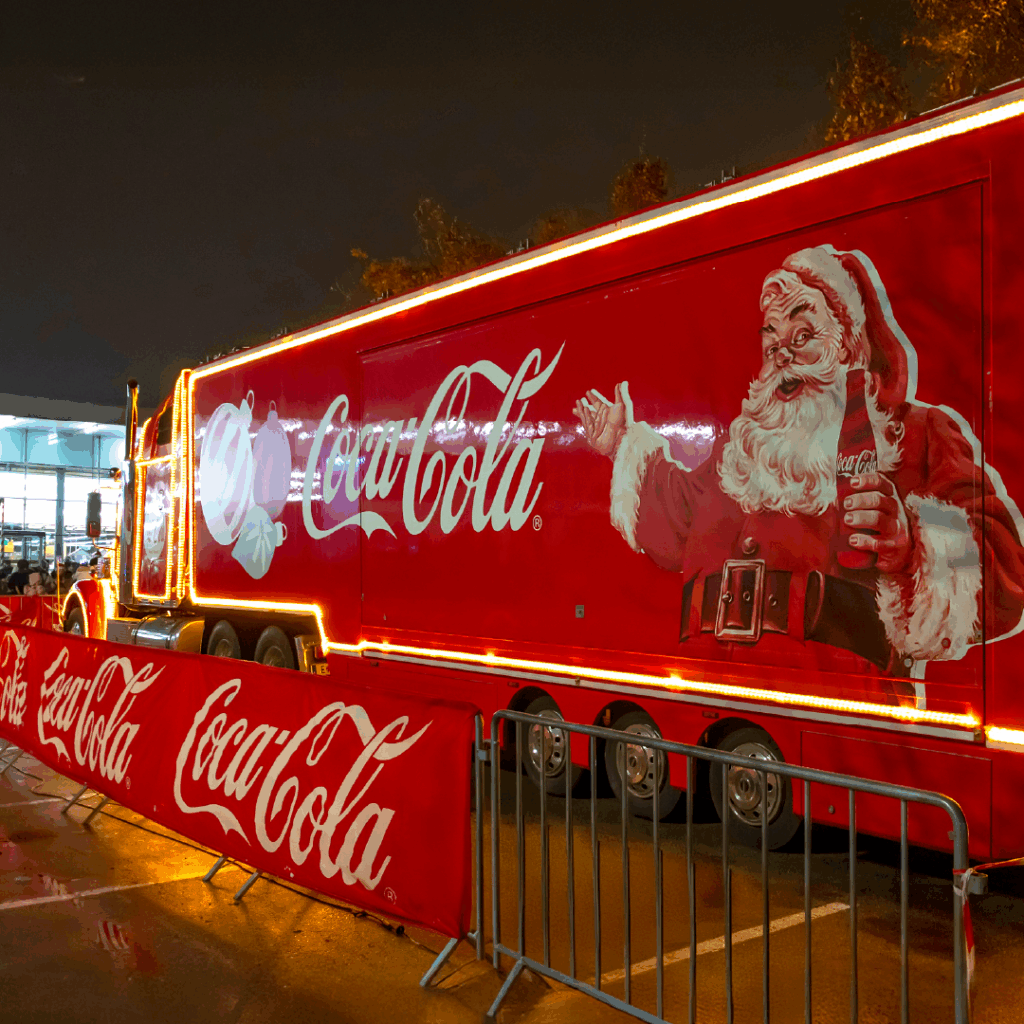
If Santa is the character and the Bears are the mascots, the Christmas Trucks are the soundtrack.
Launched in 1995, the “Holidays Are Coming” truck advert is perhaps the most successful use of audio branding in history. The moment that sleigh-bell jingle starts, the consumer’s brain releases dopamine. It is a Pavlovian response conditioned by thirty years of media spend. For many, the first sighting of the Coke truck on TV is the actual start of the holiday season.
4. The AI Experiment: A Glitch in the Matrix?
After 100 years of perfect execution, Coke made its most controversial move yet in the mid-2020s. They decided to remake the iconic “Holidays Are Coming” truck ad using Generative AI.
On paper, it made sense. Why film real trucks when you can prompt them? But the reaction was…complicated.
While the strategy was efficient, the audience immediately felt the difference. The “soul” of the 1995 original, which featured real lights, real metal, and real people, was replaced by the glossy, dreamlike sheen of AI video. The wheels didn’t turn quite right; the crowds looked a little too smooth.
It was a fascinating case study in the uncanny valley. Coke proved that you can use AI to replicate the aesthetic of Christmas, but it is much harder to replicate the feeling of it. It served as a stark reminder to the industry: consumers can subconsciously tell the difference between “crafted” and “generated,” especially when it comes to their most nostalgic memories.
The Takeaway
Coca-Cola’s dominance is built on a century of playing the long game. They didn’t win by chasing trends; they won by picking a story (Santa, the Bears, the Trucks), and sticking to it until it became history. However, their recent AI pivot taught us all a valuable lesson for 2025: Nostalgia is fragile. You can modernize the delivery mechanism, but if you mess with the magic too much, you risk breaking the spell.