
How the Ad Break Became the Show: The Evolution of Super Bowl Advertising
5 Minute Read
In the ’80s, a Super Bowl “party” meant nothing more than a living room with a few relatives and the kind of snack spread that felt ambitious if it included more than one dip. Your dad was in a recliner, complaining about the calls, the original Armchair Quarterback before it was a meme. Kids were on the carpet, half-watching, half-wrestling, half-trying to balance a paper plate of nachos without leaving orange fingerprints on the upholstery.
And commercials? Commercials were just…commercial breaks.
They were the built-in intermissions where adults refilled drinks, someone yelled, “Who wants more chips?”, and you sprinted to the bathroom like it was a two-minute drill. If you were a kid, the ad break was permission to get up and cause trouble, roughhouse with your siblings. Toss a Nerf football down the hallway and try to make it back before the whistle.
Back then, the relationship between the Super Bowl and advertising was mostly transactional: brands bought time, viewers tolerated it, and everyone returned their attention to the “real” show.
Then Mean Joe Greene walked into that world and changed the rules.
Not literally, of course. But that’s what it felt like. A football hero, battered and exhausted, limping down a tunnel. A kid looking up at him with the kind of awe you only have before you learn cynicism. The kid offers him a Coke. Greene takes it, drinks, softens. And then comes the moment that turns a commercial into a memory: the jersey tossed back with a simple, human payoff.
“Hey kid… catch.”
From then on, the Super Bowl didn’t just contain commercials. It became a platform for them.
Fast-forward to now, and that “platform” has grown into its own kind of show, and sometimes even the main attraction, depending on the matchup. Commercials don’t just appear on game day; they arrive early as teasers, trailers, and previews, like movie studios dropping hype before opening night. Which makes what Skittles is doing feel like the inevitable next step: instead of fighting for attention inside the broadcast, they’re turning the ad into a real-world moment, partnering with Gopuff to deliver a live “commercial” to a fan’s front door on game day, complete with Elijah Wood.
To see how we got from living-room intermissions to ads that can show up at your house, here’s a quick highlight reel; just a sampling of the commercials that helped shape each era.
1980 – Coca-Cola: “Hey Kid, Catch!” (Mean Joe Greene)
A simple, human story that proved a commercial could feel like part of the game-day experience. The Super Bowl didn’t just air it; it helped canonize it. (Re-aired during Super Bowl XIV.)
1984 – Apple: “1984”
The moment Super Bowl ads went from “fun break” to cultural premiere. It didn’t just sell a product—it announced a brand as a movement.
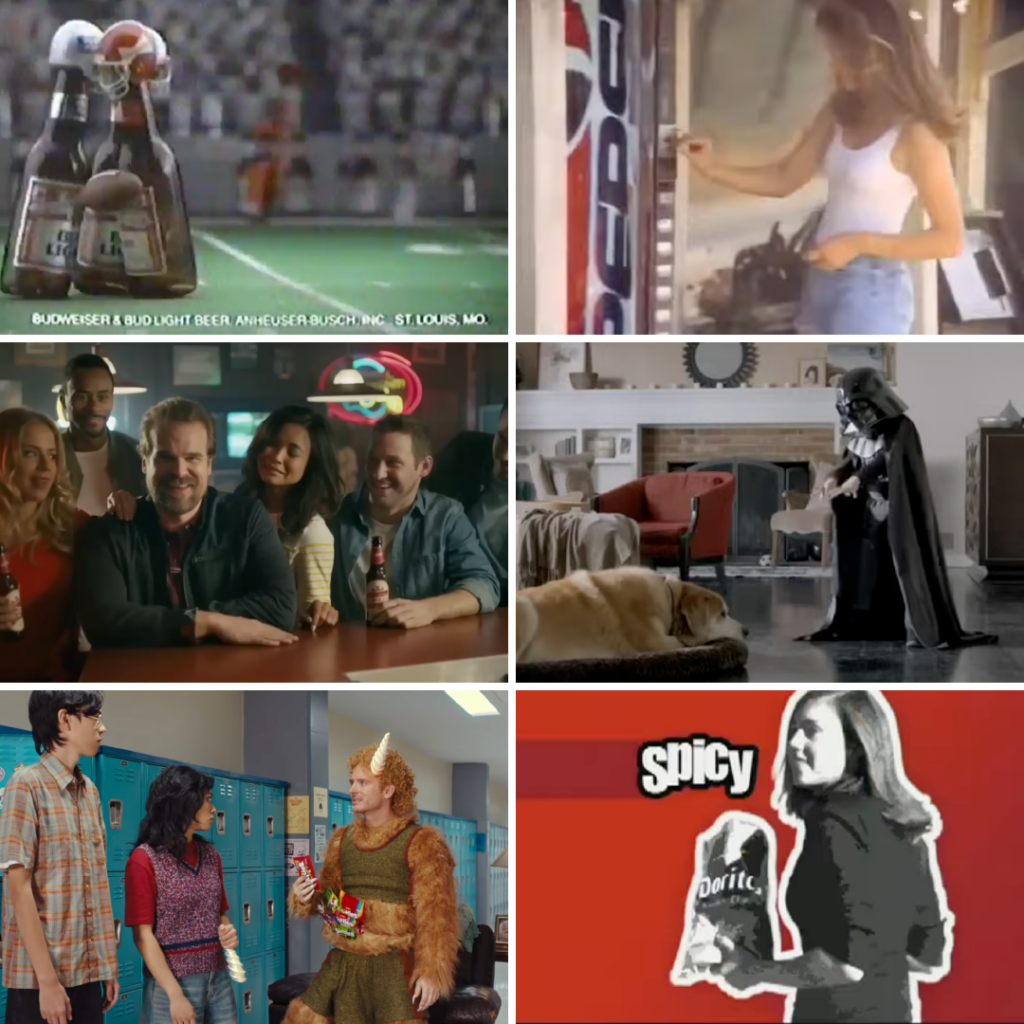
1989 – Budweiser: Bud Bowl
Commercials stopped being one-and-done and started acting like a recurring show inside the broadcast. It trained people to pay attention during breaks because the breaks had a storyline.
1992 – Pepsi: Cindy Crawford “Just One Look”
The ’90s celebrity spectacle era arrives: glossy, iconic, and instantly repeatable as pop culture.
1993 – McDonald’s: “The Showdown” (Jordan vs. Bird)
Proof the Super Bowl could host “event commercials” built on star power and friendly competition…basically a short film with a punchline and a catchphrase.
1995 – Budweiser: “Frogs”
A masterclass in absurd, character-driven humor that became instantly quotable and massively imitated—very ’90s, in the best way.
1999 – Monster.com: “When I Grow Up”
One of the first internet brands to truly feel mainstream on Super Bowl Sunday: smart, slightly dark, and perfectly timed for white-collar late-’90s reality.
2000 – E*TRADE: “Monkey / Wasted Two Million”
Peak dot-com swagger: a self-aware joke about the cost of the ad itself, which is exactly the kind of flex that only makes sense in a bubble.
2007 – Doritos: “Crash the Super Bowl” (UGC era)
Doritos let everyday people make the ads, and then put them on the biggest stage possible. It was a preview of the creator economy before anyone had a name for it.
2011 – Volkswagen: “The Force”
The Super Bowl ad era went digital: hype and sharing started before kickoff. The game became the “premiere,” but the internet became the amplifier.
2011 – Chrysler: “Imported from Detroit” (Eminem)
Car ads stopped just selling horsepower and started selling identity, pride, and place. It was less “look at the vehicle” and more “feel what we stand for.”
2018 – Tide: “It’s a Tide Ad” (David Harbour)
Tide hacked the viewer’s ad radar by turning every familiar Super Bowl trope into a bait-and-switch. It rewarded audiences for being media-literate and made the joke the strategy.
2026 – Skittles: “Deliver the Rainbow” (lead-up spot)
Skittles set up an ad you can’t pause, skip, or mute by releasing a teaser that invites fans to win a live, in-person commercial performed at their front door by Elijah Wood, built around its delivery partnership with Gopuff.
Somewhere along the way, the Super Bowl stopped being a game with commercials tucked inside it and became a show where the commercials sometimes steal top billing. Depending on the matchup, you’ll still get the football diehards who treat every ad break like a personal betrayal, but you’ll also get entire living rooms judging the night by a different scoreboard: which spots landed, which ones flopped, and which brands somehow made you stop mid-chip to actually watch.
And here’s the biggest change: Super Bowl ads don’t start on Sunday anymore. Brands now roll out teaser trailers, behind-the-scenes clips, “announcements of the announcement,” and early releases in the days (sometimes weeks) leading up to kickoff, because the real prize isn’t just airtime, it’s attention that lasts longer than 30 seconds. Publications have been tracking how and why marketers lean so heavily on pre-game teasers and early drops, especially as social and mobile viewing made sharing part of the ritual. One of the cleanest proof points is Volkswagen’s “The Force” era, when the online version hit YouTube before the game and racked up massive views ahead of kickoff; an early signal that the “Big Game moment” could start early and live everywhere.
That’s what makes Skittles such a perfect “welcome to modern advertising” example, because it doesn’t just tease the ad early. It rewrites what an ad is. Instead of buying a traditional in-game TV spot, Skittles is staging the commercial as a live performance delivered to one fan’s front door on game day, built around its delivery partnership with Gopuff and featuring Elijah Wood. The brand is essentially saying: if ads are something people skip, mute, or scroll past, we’ll make one you can’t, because it shows up in real life, and the internet will do the rest.