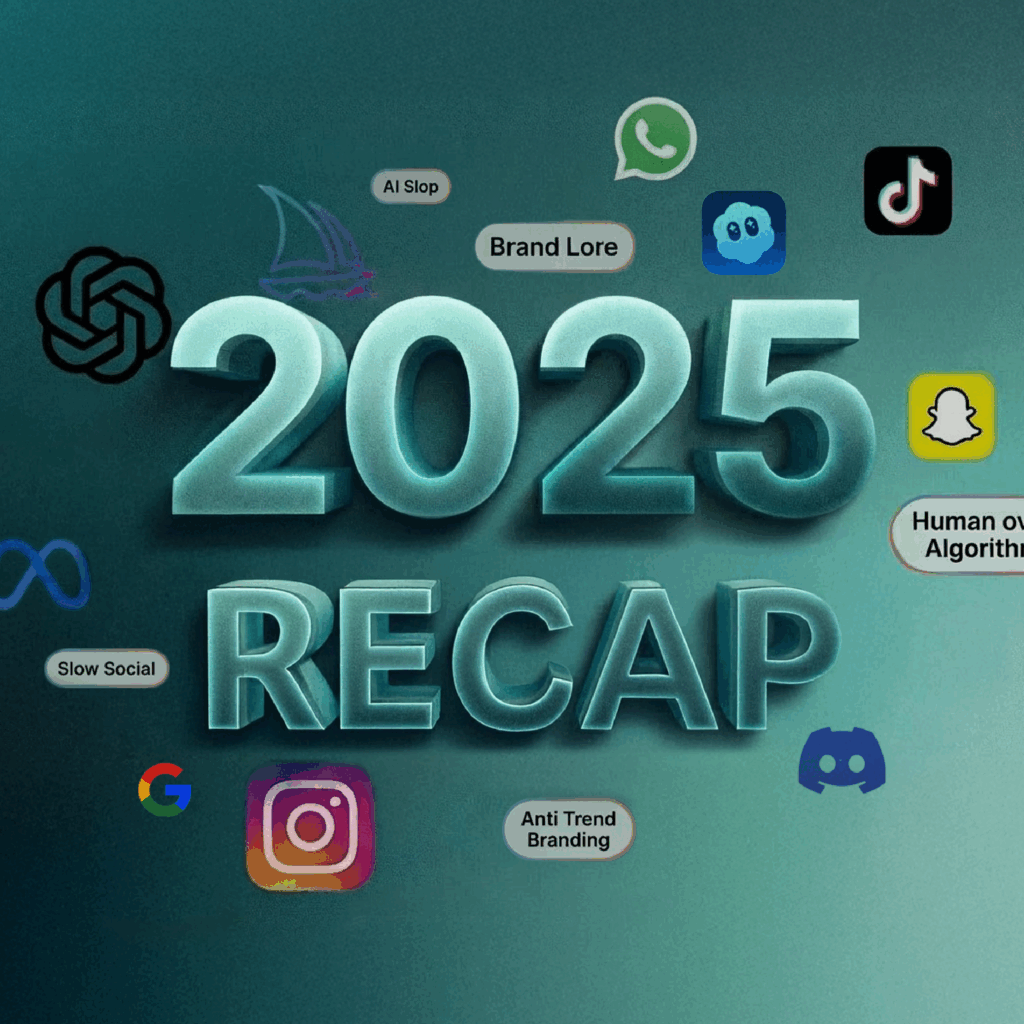

The Year The Dust Settled: A Creative Retrospective on 2025
4 Minute Read
If 2023 was the year AI scared us, and 2024 was the year we panic-adopted it, 2025 will go down in history as the year the dust finally settled. We are nearing the end of the year, and the creative industry feels… different. Calmer, perhaps? Or maybe just more intentional.
Looking back at the predictions made twelve months ago, it’s funny to see what stuck and what flopped. We were promised a world run by “AI Agents” and a complete exodus from traditional social media. Did it happen? Sort of. But as usual, human behavior proved more nuanced than the algorithms predicted.
Here is a look back at the marketing trends that defined 2025: the ones that were right, the ones that were wrong, and the ones that saved our sanity.
1. The “AI Slop” Backlash & The Premium on “Human”
The Prediction: AI would democratize creativity, allowing anyone to generate high-fidelity assets in seconds.
The Reality: It did, and we hated it.
By Q2, the internet was drowning in what cultural critics started calling “Grey Goo” or “Slop,” essentially mid-journey generated stock images with that uncanny, glossy sheen and chatbot-written captions that all sounded vaguely like a corporate HR manual.
The Creative Pivot:
The brands that won 2025 weren’t the ones using AI to do everything; they were the ones using AI to do the boring stuff (data sorting, versioning) so they could double down on the messy, imperfect human stuff. We saw a massive return to Lo-Fi Authenticity.
- What worked: Hand-held camera work, grainy textures, unpolished employee-generated content (EGC), and copy that actually sounded like it was written by a person with a pulse.
- What didn’t: The “perfect” AI avatar influencers. Audiences sniffed them out and swiped past. We craved eye contact, even if it was through a screen.
2. Social Went “Dark” (In a Good Way)
The Prediction: Social media platforms would decline due to fatigue.
The Reality: Public feeding frenzies declined; private communities exploded.
The “Town Square” era of social media officially ended this year. The algorithm fatigue we predicted in 2024 hit hard. People were posting less to their main grids and started posting more to their “Close Friends” lists, Discords, and broadcast channels.
The Creative Pivot:
Marketing had to get smaller to get bigger. The “Niche Community” trend was the absolute winner of 2025.
- The Win: Brands that stopped shouting at the masses and started whispering to the superfans. The rise of “Broadcast Channels” on Instagram and WhatsApp became the highest-converting channel for many. (1)
- The Shift: Engagement metrics like shares and DM sends finally overtook likes as the primary KPI. If it didn’t get sent to the group chat, it didn’t happen.
3. The “Lore” Era: From Campaigns to Canon
The Prediction: Attention spans are dead. If you can’t say it in 6 seconds, don’t say it at all.
The Reality: Attention spans weren’t dead; they were just starving for depth.
One of the biggest creative surprises of 2025 was the return of World-Building. We spent years fragmenting our brands into disconnected, bite-sized hooks for the algorithm. But in 2025, audiences started demanding “Lore.” They didn’t just want a funny skit from a mascot; they wanted the mascot’s origin story, its rivals, and a recurring cast of characters.
The Creative Pivot:
We stopped thinking in terms of “Campaigns” (which have a start and end date) and started thinking in terms of “Canon.”
- The Shift: The most successful creative teams this year operated less like ad agencies and more like TV writers’ rooms. We saw CPG brands and tech companies building “Cinematic Universes” on TikTok and Reels.
- What Worked: Continuity. The brands that won were the ones that planted Easter eggs in Q1 that didn’t pay off until Q3. It gamified the viewing experience. We learned that if you give the audience a thread, they will pull it, and they’ll stay engaged for way longer than 6 seconds to see what unravels.
4. “Slow” Video vs. The Dopamine Hit
The Prediction: Short-form video would continue to shrink attention spans.
The Reality: A surprising counter-trend emerged: “Slow Social.”
Yes, 15-second reels are still king for reach. But in 2025, we saw the rise of “ambient” content and longer, episodic storytelling. Perhaps it was the collective burnout from the frantic “millennial pause” editing styles of previous years, but audiences started rewarding videos that let them breathe.
- The Vibe: “Minimalist Maximalism” became the aesthetic of the year. Visuals were bold and surreal (often aided by AI tools like Sora), but the pacing was slower. Think: a 60-second video of a product in a surreal landscape with just ASMR sound, rather than a creator screaming at the camera.
5. The “Anti-Trend” Brand
The Prediction: Brands would need to jump on micro-trends faster than ever.
The Reality: Trying to keep up became embarrassing.
By mid-2025, “Trend-Jacking” started to feel cringe. The lifecycle of a meme shortened to about 48 hours. If a brand posted a “skibidi” reference (sorry to bring that up) three days late, they were roasted.
The Creative Pivot:
The smartest creative directors this year hit the brakes. They stopped chasing the Sound of the Week and went back to Brand Codes. The brands that stood out were the ones that looked like themselves, regardless of what the algorithm was doing. 2025 taught us that consistency is the only antidote to chaos.
The Verdict?
2025 wasn’t the sci-fi dystopia some feared, nor the utopia tech bros promised. It was a year of correction.
We learned that AI is a great co-pilot but a terrible captain. We learned that while algorithms control distribution, emotion still controls attention.
As we look toward 2026, the brief is clear: Use the tech to save time, but use your humanity to save the brand.
Work Cited
- The Verge, https://www.theverge.com. Accessed 3 December 2025.